


Hyundai Santa Fe Hybrid Calligraphy long term review
Our 2025 Car Of The Year transforms into a car to use every day for six months and 10,000 kilometres. To see if we were right or oh-so wrong…
The latest addition to the Chasing Cars long term garage requires little rationalisation or justification. Hyundai’s Santa Fe large SUV was crowned our 2025 Car Of The Year.
And what better way to see whether it deserves our highest accolade – specifically, if its goodness and prowess in review maintains staying power in ownership – is to live with it for six months and 10,000 kilometres.
The stakes are unusually high for this long-termer. As is customary, the vehicle’s credentials and cracks come under particularly close scrutiny. But so does the Chasing Cars’ team assessment – were we right or wrong?
And it also brings focus on the business of media’s review craft – whether our short-term tests reflect the live-in experience – through the lens of a big-stakes Car Of The Year competition.
Specifically, through this mulit-part web review and through our YouTube channel, I’ll take the claims in our Car Of The Year winner narrative and seek to confirm or debunk them. What did we get right and what did we get wrong?
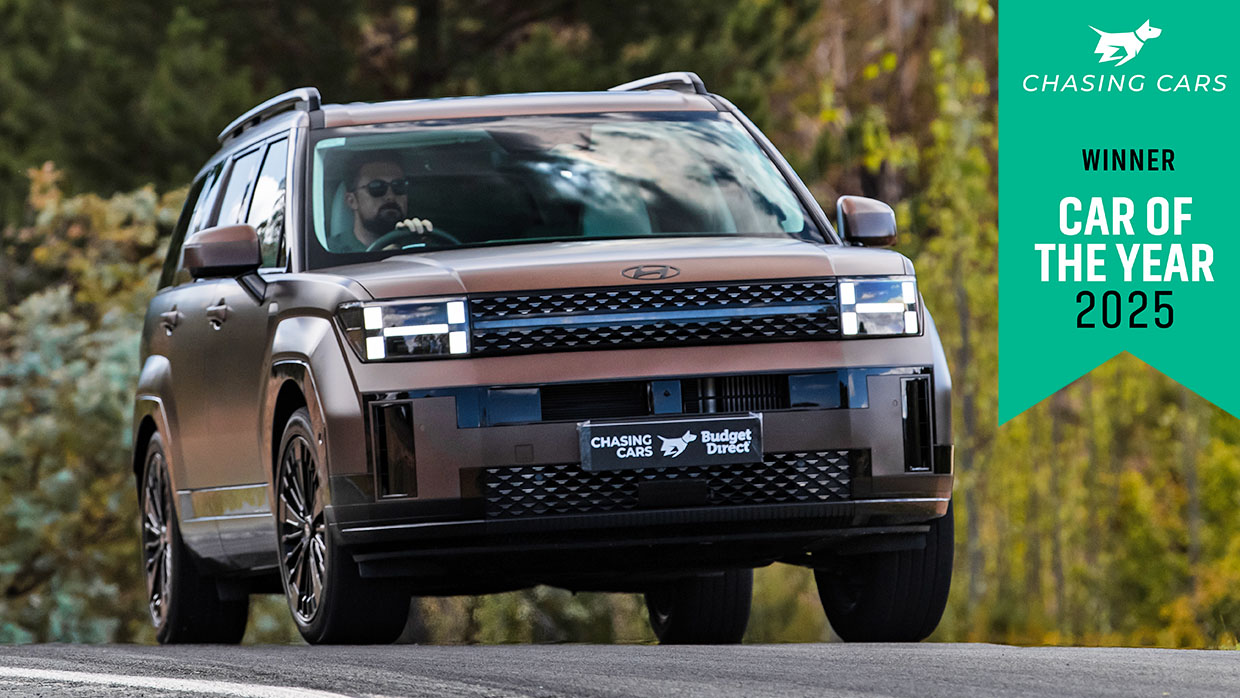
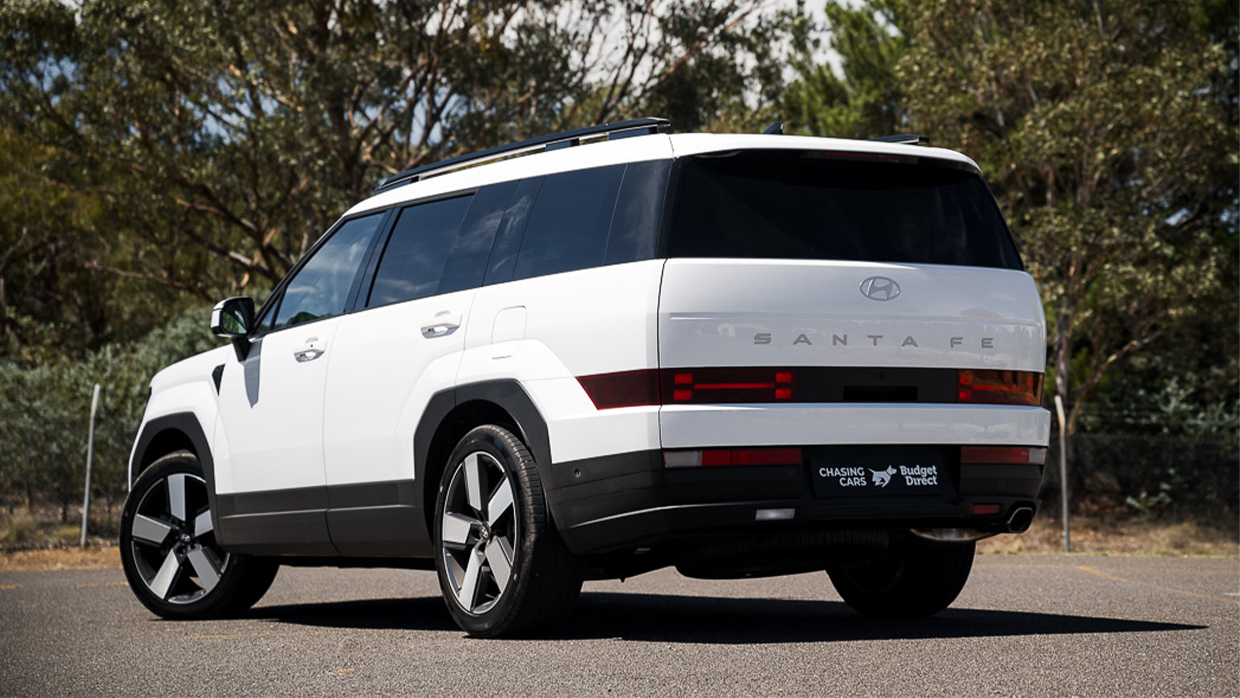
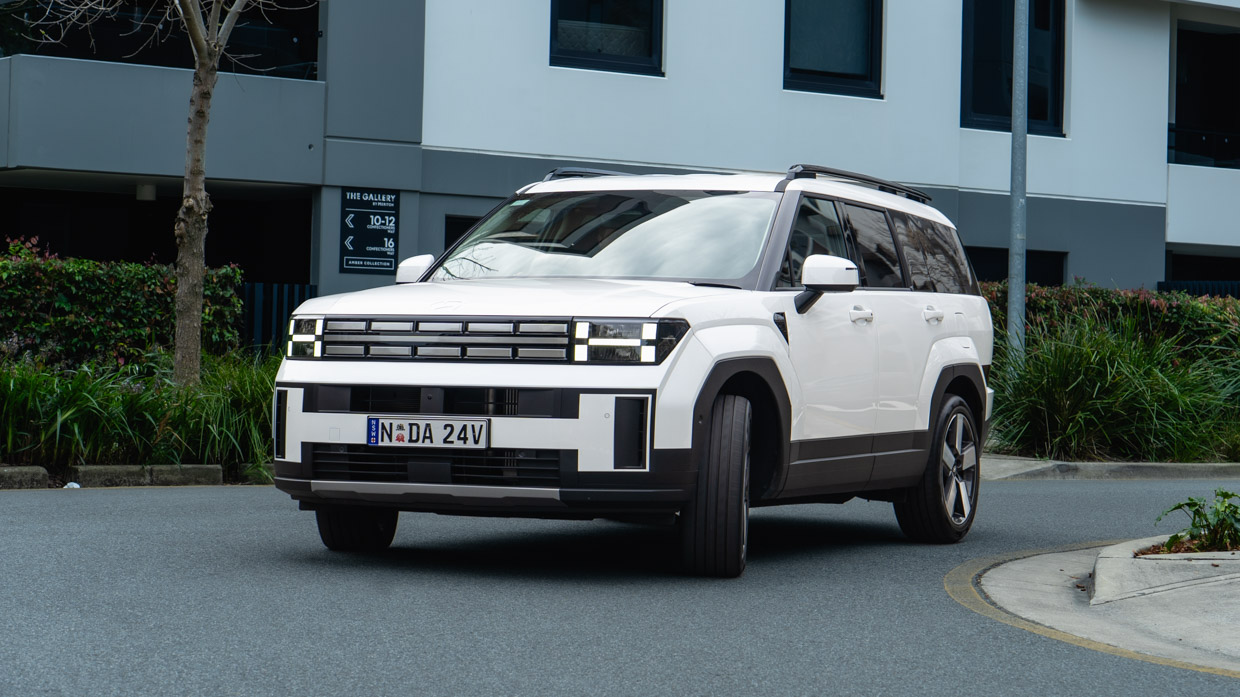
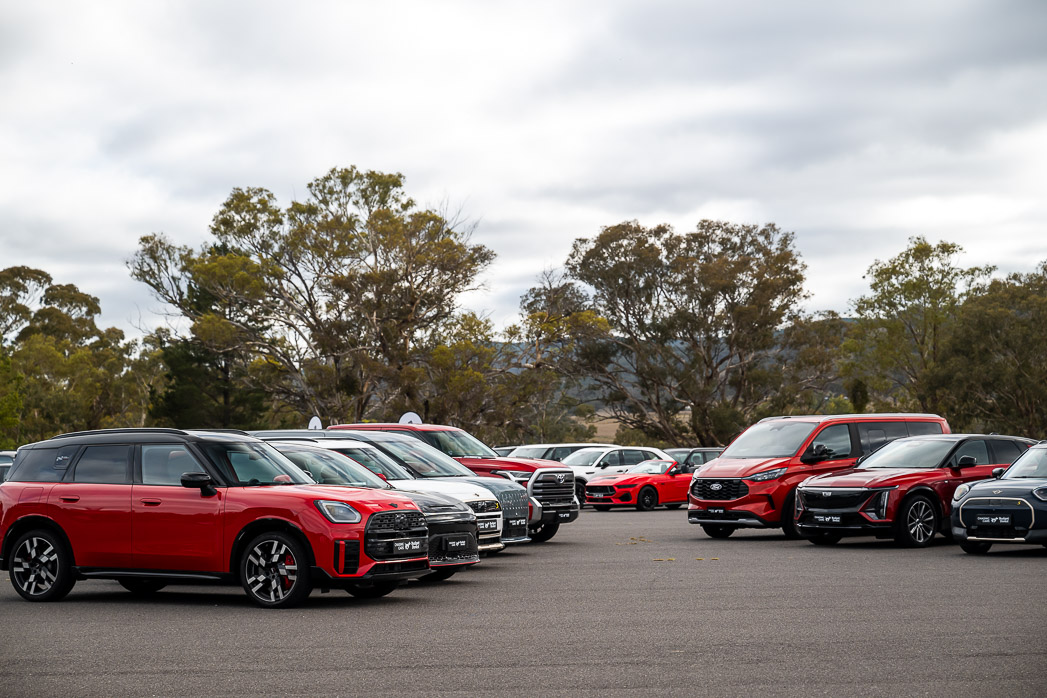
Pictured: our 2025 Car of the Year winner
Simple? Not exactly…
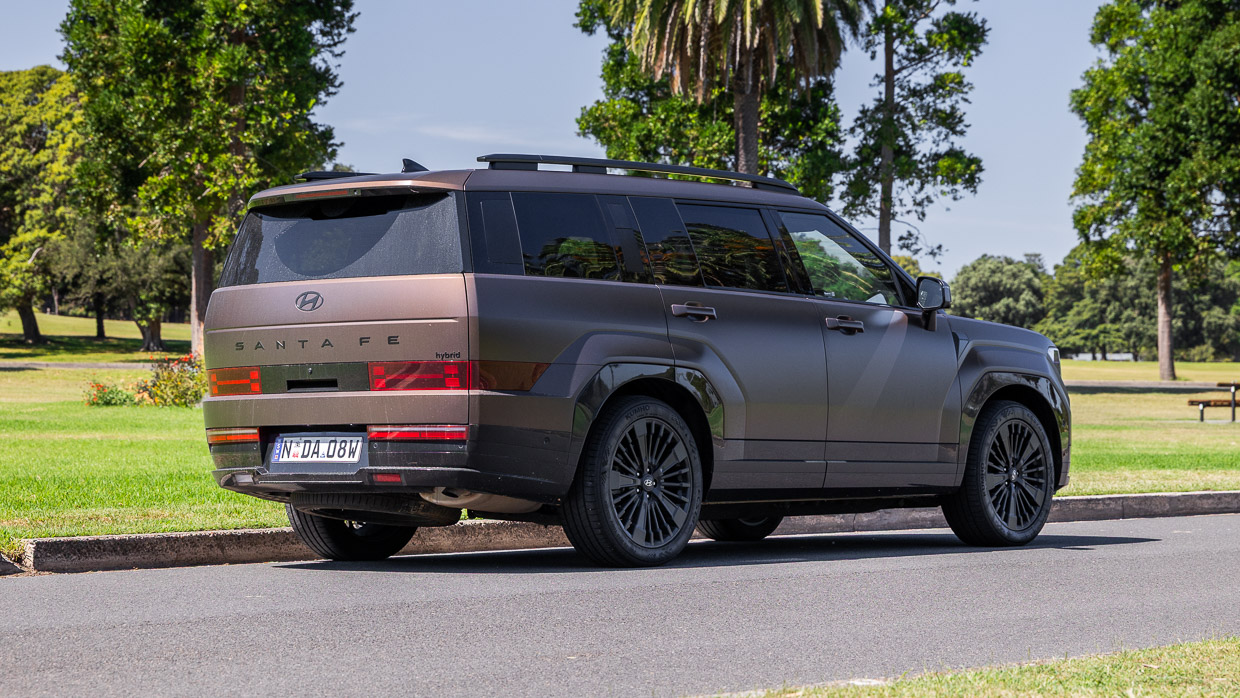
Formally, the Santa Fe range won the Chasing Cars’ 2025 COTY gong. We had three examples at our week-long shootout earlier this year, and none of them happened to be the Calligraphy Hybrid seven seater spec that has landed at CC HQ for the next six months…
In our COTY video extravaganza, judge Nathan Ponchard said the ‘COTY Calligraphy’s’ two-tone Forest Green interior was “just like a 1970s Italian supercar, while its six-seat format brought “a $150,000 SUV feel in a $75K Hyundai.” Perhaps.
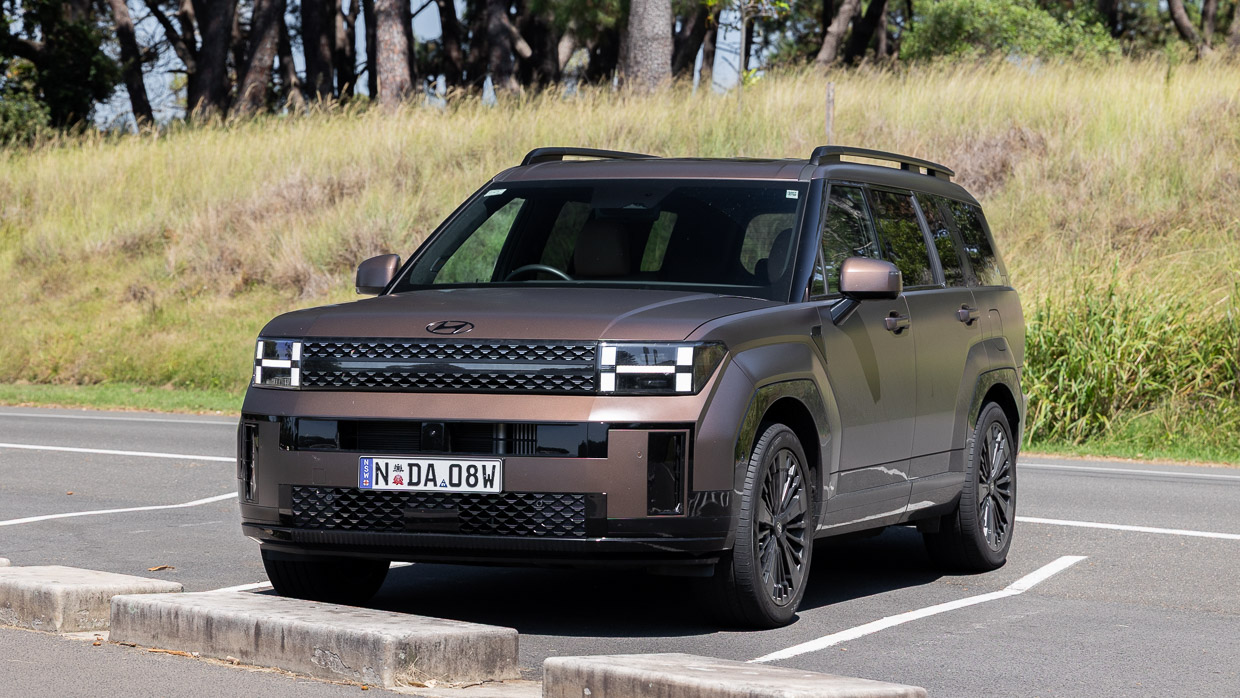
Pictured: the base Santa Fe with the punchy 2.5T
However, our long-termer has a two-tone Pecan Brown ‘regular’ seven-seat arrangement…
Elsewhere in the COTY plaudits, editor Jez Spinks gushed that the newly introduced turbo 2.5-litre petrol powertrain is “so much better than the 3.5-litre V6 that it essentially replaces from the previous generation,” adding that it was “our favourite of the two [available] drivetrains.”
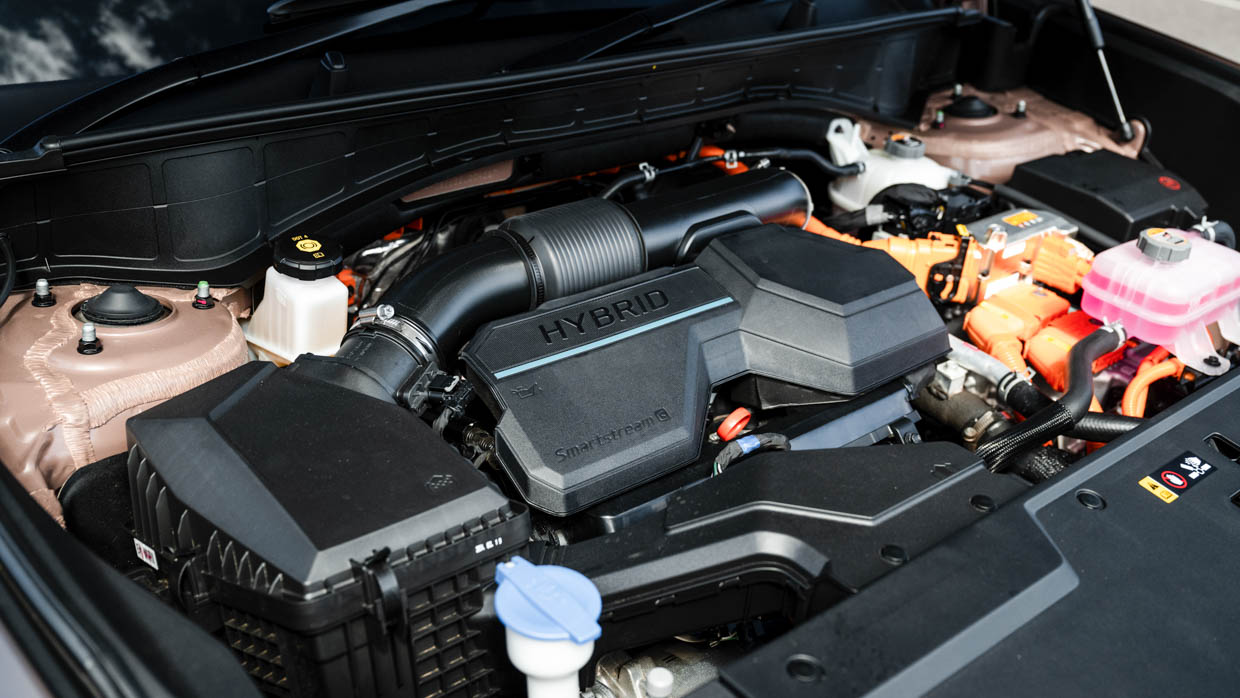
However, our long-termer is the 1.6T hybrid, AKA the <less favourable> of the two available Santa Fe powertrain options. Hmm. Still, Spink remarked that the hybrid’s “high-six-litre consumption” was “pretty amazing.” At least there’s that little nugget to put to the test…
Meanwhile, Chasing Cars founder Tom Baker said that “this is a family SUV you’d be proud to have in your garage or on your driveway,” though that was the base petrol variant.
“The Hyundai Santa Fe is one of those rare vehicles that doesn’t have a weak link in the range,” Spinks concluded at 2025 COTY, adding that “it’s almost faultless.”
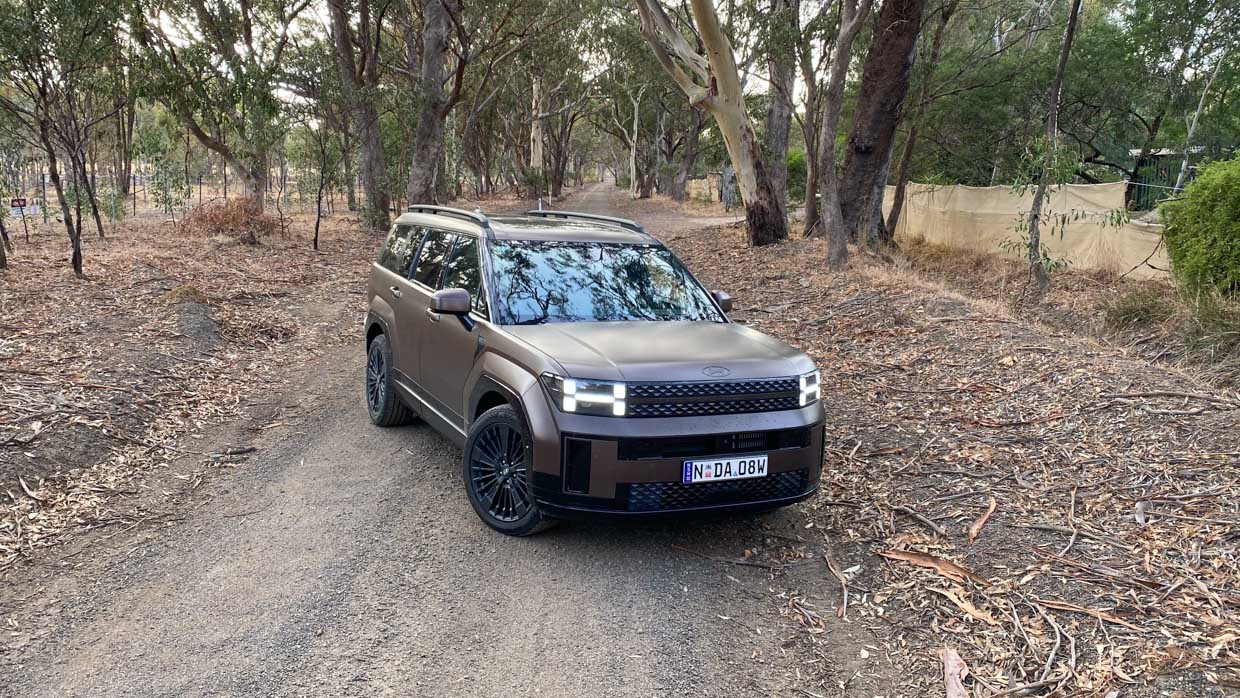
We’ll see about that…over the next six months or so, in our Calligraphy Hybrid seven seater that clocks in at $76,500 before on-roads – plus $1000 for its a Earthy Brass Matte
paintwork – as priced at the kick-off of our long-term adventure.
Navigate this long-term Hyundai Santa Fe Hybrid Calligraphy review
- Month 1: The wrong Santa Fe?
- Month 2: A different kind of family hauling
- Month 3: How much does Chasing Cars weigh?
- Month 4: The cheap seats
Month 4: The cheap seats
Is the Calligraphy $25K better than the base Santa Fe?
We’re past the mid-loan hump and Santa has returned faithful and faultless service to plenty of the <Chasing Cars> crew, including videographer Ky Riordan’s minus-five-degree skiing jaunt to Thredbo in the height of the snow season.
While its on-demand all-paw traction proved a godsend in the ice slush, Santa – as we’ve nicknamed the Calligraphy – has never been quite right since day one. A somewhat loose ride and handling blend. Aloof steering feel. A few too many squeaks on the move…
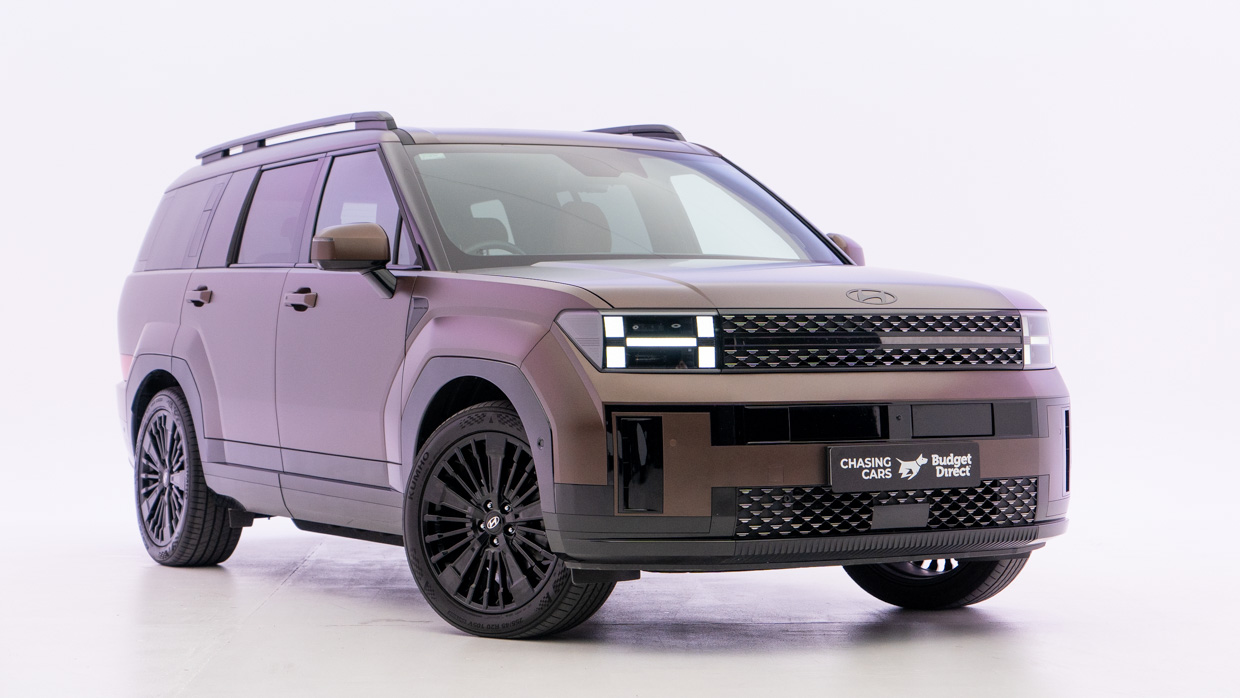
One question lingered: were we too generous handing the 2025 Car of the Year to Santa Fe, or is Santa our long-termer simply not the fittest specimen of an otherwise stellar breed?
Then a no-nicknamed, plain white, base 2.5L turbo petrol fronted up to the Chasing Cars garage, at $53,240 list – or around $58K and change on road – as cheap as Santa Fe gets. Quite the counterpoint to our long-termer that, at $77,785 list or $85K-ish on road with options, is the second-priciest specification good money can buy.
Quite unexpectedly, our basic week-long loan ‘short-termer’ proved the more desirable option.
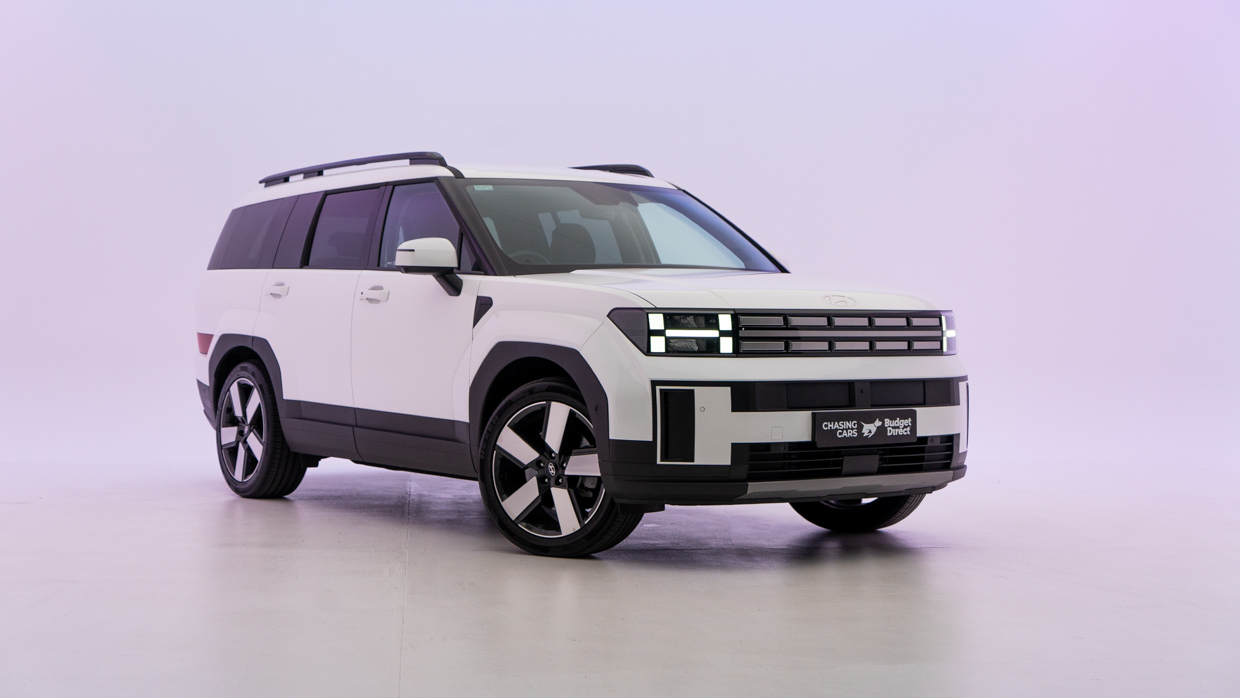
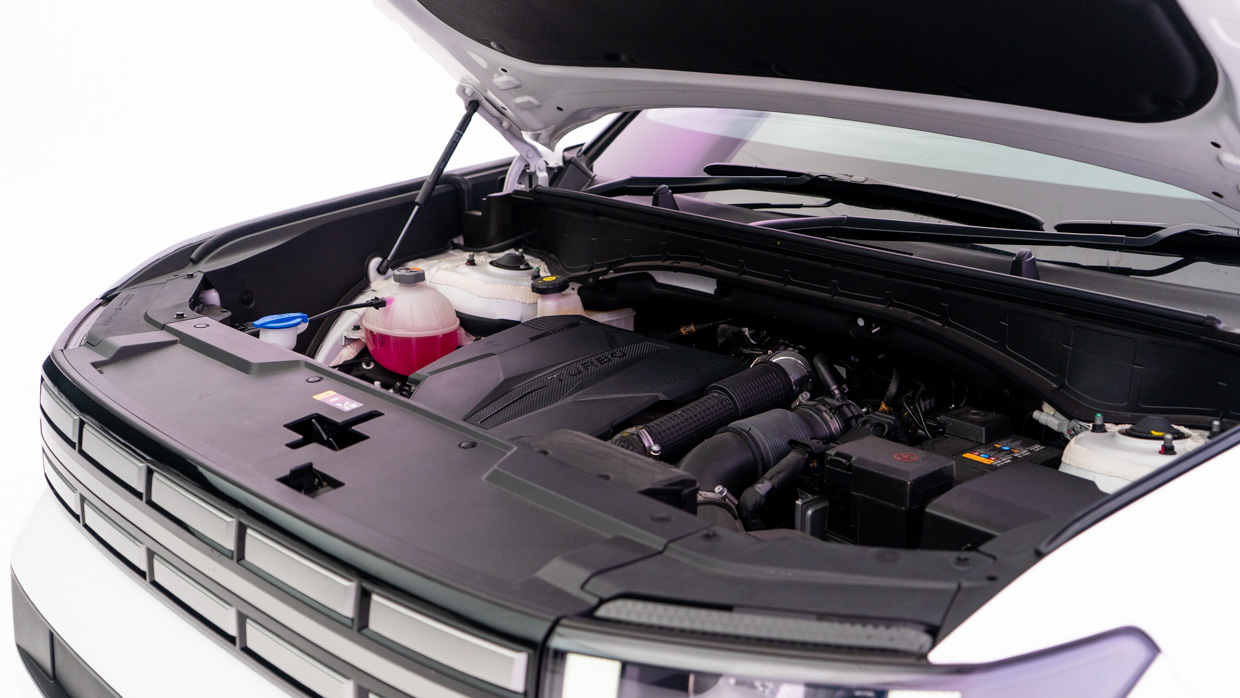
At 206kW and 422Nm, the newly introduced 2.5 turbo replacement for the now defunct 3.5 natural aspirator, outpunches Santa’s 172kW and 367Nm 1.6T hybrid combination by a fair measure.
As the base front driver omits rear axle propulsion the hybrid gubbins, it is, at around 1850kg, almost a quarter tonne lighter than the Calligraphy, too.
Sprightlier performance is matched with – hello, hello – a tauter chassis and more confident steering feel which leave the base petrol, sat on identical 20-inch rolling stock spec, feeling fitter and more athletic as well.
There’s more. Because the 2.5-litre turbo four doesn’t work as hard as the hybrid’s (132kW and 265Nm) 1.6, it’s far less vocal when it comes on song…which is abruptly when you are on the move, as is the case with the hybrid. Thus, the base car is generally quieter and more refined on balance. Didn’t see that coming…
It’s not perfect. The front driver torque steers noticeably. And in Sport mode, it can spin up the front left tyre ferociously. Maybe the $3K upcharge for all-wheel drive is a worthwhile investment…
So our Creamy White base machine is not only around $25K cheaper, but offers more performance, crisper handling, identical ride quality (it would transpire) and quieter running with more general refinement. What’s the trade off?
For one thing, fuel economy. Our long-termer pins itself faithful to the mid-6.0L/100km seemingly no matter where and how it’s driven (slightly worse than its 5.6L claim).
Meanwhile, the turbo petrol averages in the high nines and scales in the tens around town, or better than its claim (9.3L combined, 13.3L urban).
So…the hybrid benefits roughly two litres per hundred at around $1.80-ish for the 91RON either steed drinks. Call it 300 litres per annum thriftier (on a rough 15,000km average) for an annual saving of a not insignificant $540 per year.
Therefore, it’d take 46 years of driving and almost 700,000 kilometres of ownership to break even against our long-termer’s $25K premium…
Of course, none of this takes into account the features disparity between the base spec and the flagship. But right here is where the entry ‘no-name’ Santa Fe really starts to impress for its outlay.
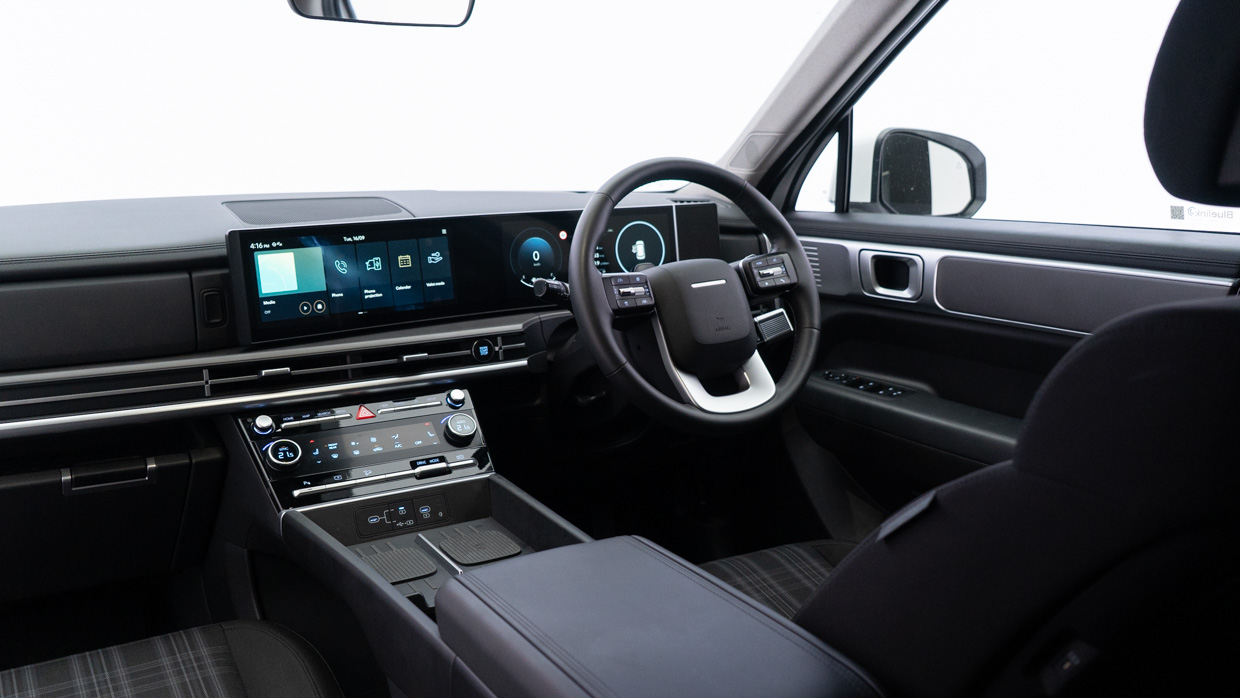
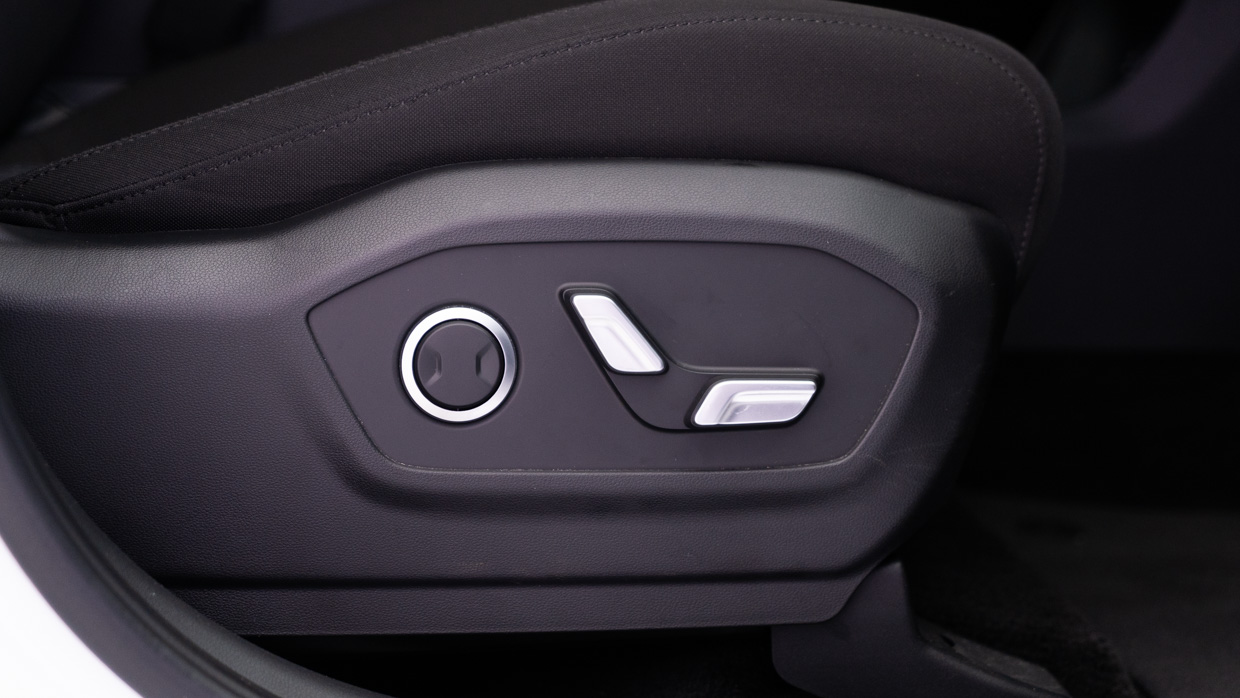
Dual 12.3-inch displays, 10-way power adjustable driver’s seat, dual-zone climate, 360-degree cameras, inductive charging…the list of standard base Santa Fe features is not merely lengthy, it’s nearly as fulsome as some rivals’ high-spec alternatives…let alone seven-seat choices that duck under $60K on road.
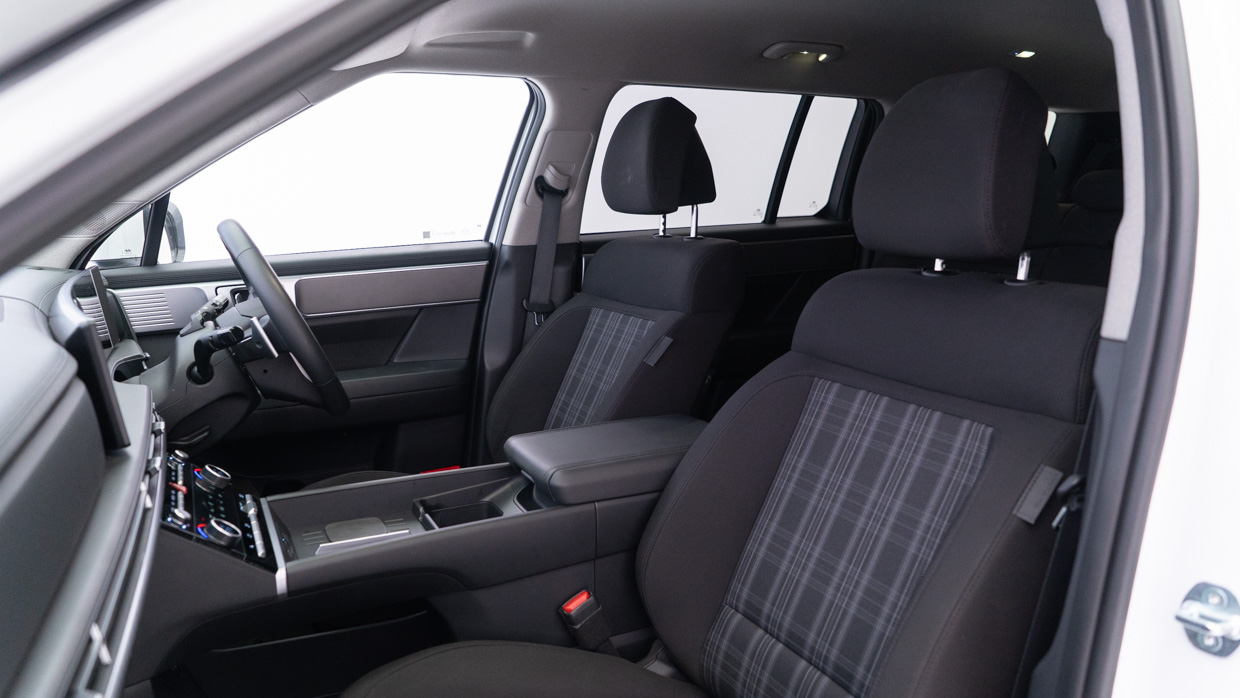
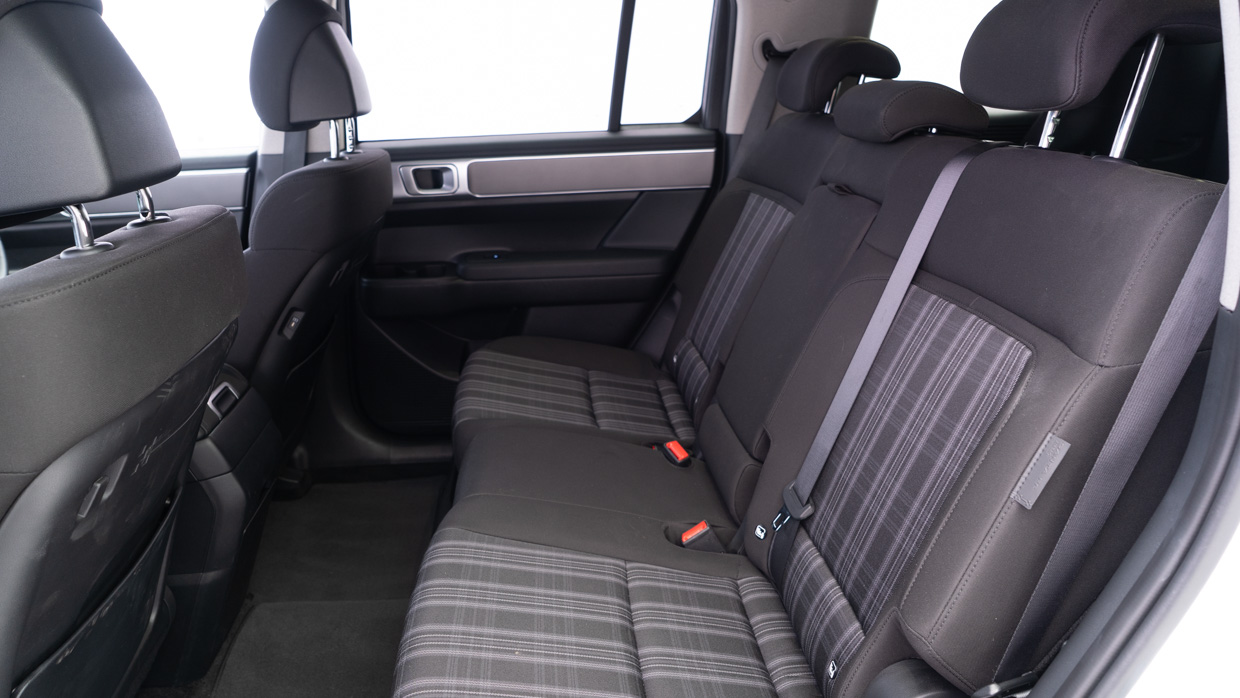
Even the humble stuff is solid and impressive. In fact, most of the crew preferred the black and grey cloth base trim to the brown nappa stuff in the Calligraphy. But a poverty pack the base Santa Fe is most certainly not.
So while both the base and flagship Calligraphy variants are both our 2025 Car of the Year, the punchy powertrain, fulsome spec and fine execution of the price-buster has us inclined to think that the entry grade is a little <more> car of the year than its fancier range mate.
Month 3: How much does Chasing Cars weigh?
Seven seats – just because you can, it doesn’t mean you should…
Team lunch. If any two words can elicit absolute glee in the Chasing Cars audio/visual crew – Kyle Riordan and James Mort – it is this pair. In fact, a sneaky chicken parmy or seven on the work ‘golden ticket’ brings a lift to the entire office.
With Ash Leung out of office and Tom Place seconded 900 kilometres away in Melbourne – a bit of an Uber Eats stretch, to be honest – it was seven Chasing Cars bods needing convenient passage to a local pub one Thursday lunchtime. Time for ‘Santa’, our trusty hybrid Calligraphy, to live up to its seven-seat promise.
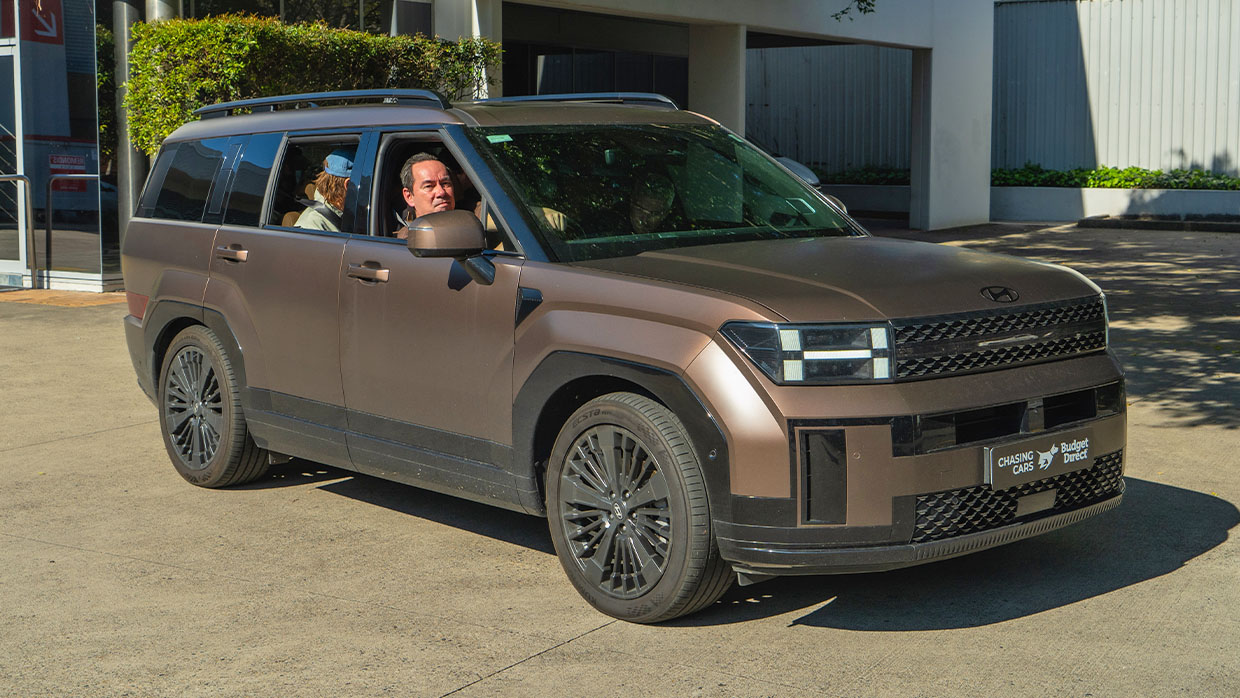
Me, Jez Spinks, Johnny Law, Evan Spence, Lukas Foyle, and the aforementioned Ky and James, all clambered into the Earthy Brass Matte lunchmachine, rowdy with hunger.
With no thanks to Google Maps, we set off across some of Sydney’s narrower back streets, through multiple roadworks, across every speed bump in the inner west…
Bang! Oof! Bang! Oof! It mightn’t have been a long trip to our lunch spot, but it was certainly a noisy one, as messers Law and Spence, sardined into the third row, wince and yelp as the Hyundai trots across each speed bump, the rear suspension crashing sharply and loudly off its bump stops.
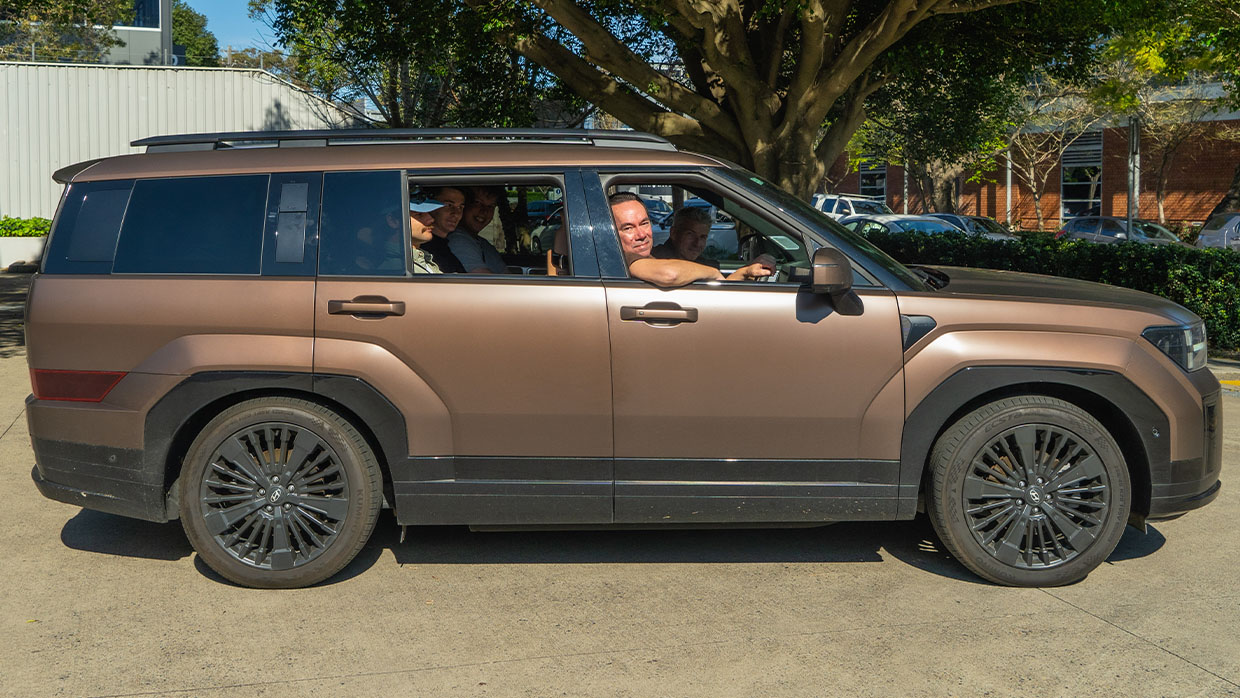
You see, nobody expected the Santa Fe seven-seater’s suspension to bottom out with seven adults aboard.
The Calligraphy hybrid seven-seater weighs 2105kg kerb, which is fully fuelled without occupants, payload and accessories (or, interestingly, 15 kegs more than the six-seater). And its gross vehicle mass (GVM) – its permissible maximum laden weight – is 2680kg. That’s 575kg of headroom, for occupants and luggage.
Back at Chasing Cars HQ, it’s a quick whip around the office to find out – within a reasonable tolerance of accuracy in honesty – how much the team weighs. He who cycles most, Johnny, is “75 kilos”…he claims. Meanwhile, he who in all evidence consumes the most calories, Lukas, is around “100 kilos”…he claims.
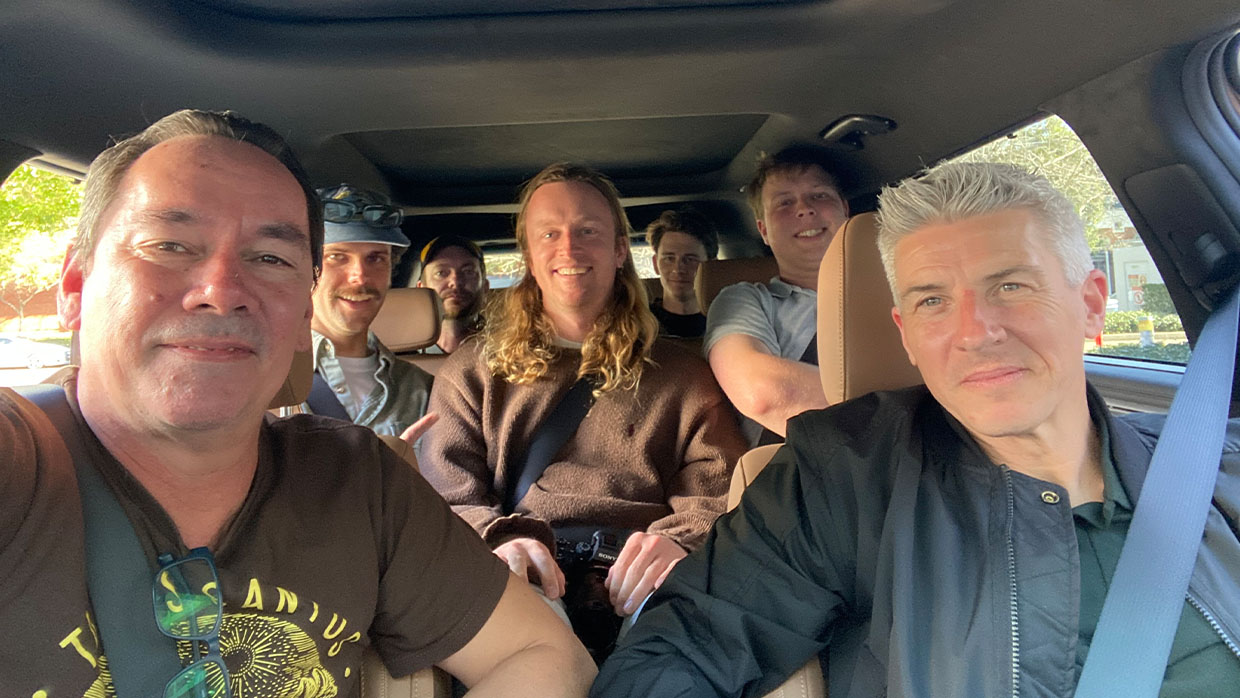
Given the rest of us ‘seem’ to land somewhere in between – most likely, on visual evidence – that would put seven Chasing Cars males collectively right on 600kg, give or take. Or 25 kilos more than Hyundai’s permissible GVM, not counting the weight of seven chicken parmies with chips and gravy…
More seriously, that’s not including luggage, of which we had none during our pub trip. The swag for a family of five’s interstate road trip might easily blast through 100 added kilograms of payload weight when filling the Santa Fe’s 628-litre boot.

While it’s easy to presume any seven-seat three-row prospect is fit for all occasions and situations, proof is that this is not necessarily true. There might be <room> for seven occupants, but maximum payload is another consideration entirely.
So a mantra was born: Seven seats – just because you can, it doesn’t mean you should. With seven Johnnies aboard, you’re probably sweet. With seven Lukases aboard, you’re illegal.
Month 2: A different kind of family hauling
Family duties. At eleven tenths. Sideways.
Who knows what horrors ‘Santa’, our long-term plus-sized Hyundai, were subjected to in its first 15,000km of life before we took delivery of it? A stint as a furniture delivery van, perhaps?
From the get-go, Santa’s interior trim would squeak, somewhere in rows two and three. Not all of the time. Not loudly. But, still, it squeaks in a manner my old Tucson long-termer ‘Ari’ certainly didn’t.
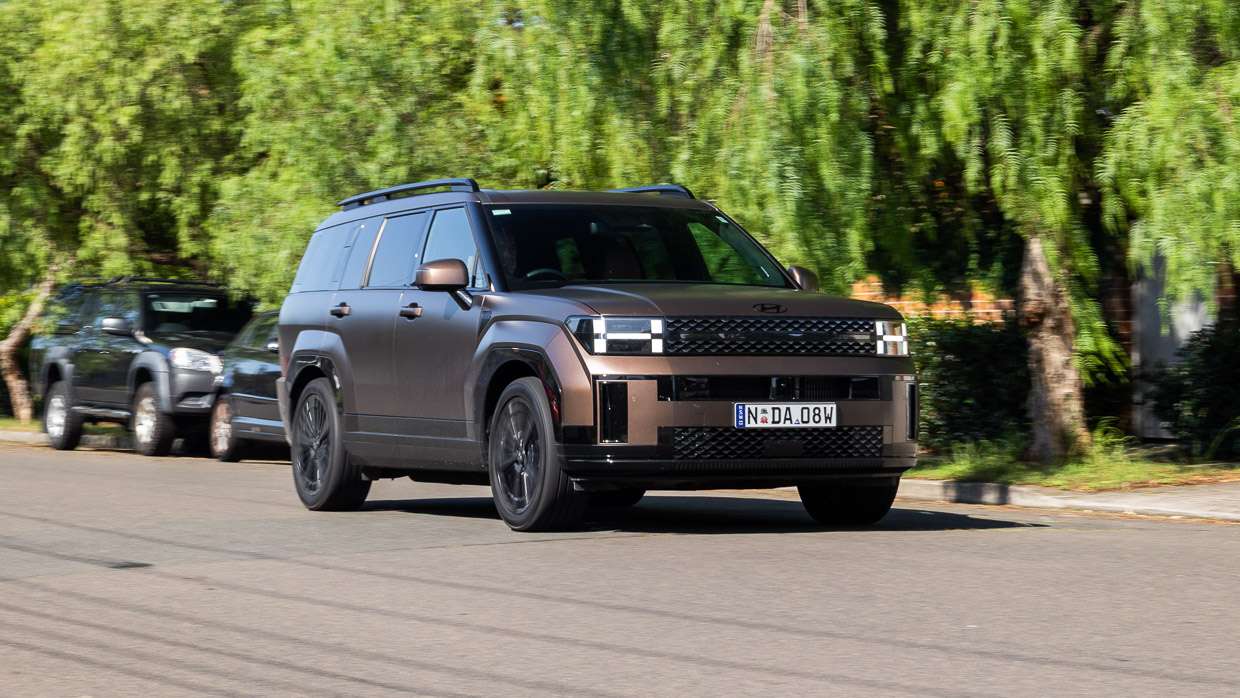
Who was Santa’s former custodian for its first 15,000kms? Australia Post?
It could be design. The Santa Fe (clearly) has a boxy structure and lots of flat, square interior trim. Perhaps the flat union between all of it creates minute movement complete with, over time, squeaking as a result.
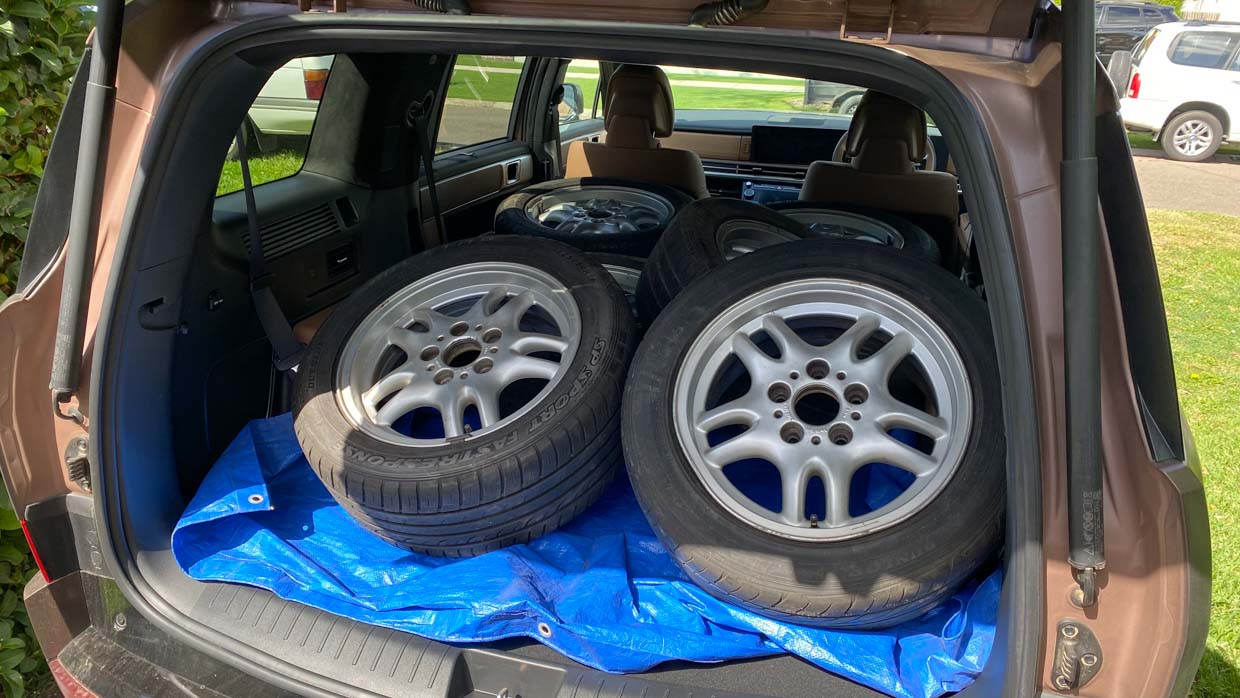
But I discovered a remedy of sorts in month two: race wheels. That is, when you drop rows two and three — liberating an advertised 1949 litres — six racecar wheels and tyres not only fit easily, they’ll squeak and squeal (as rubber rubs rubber) far louder than Hyundai’s cabin trim will.
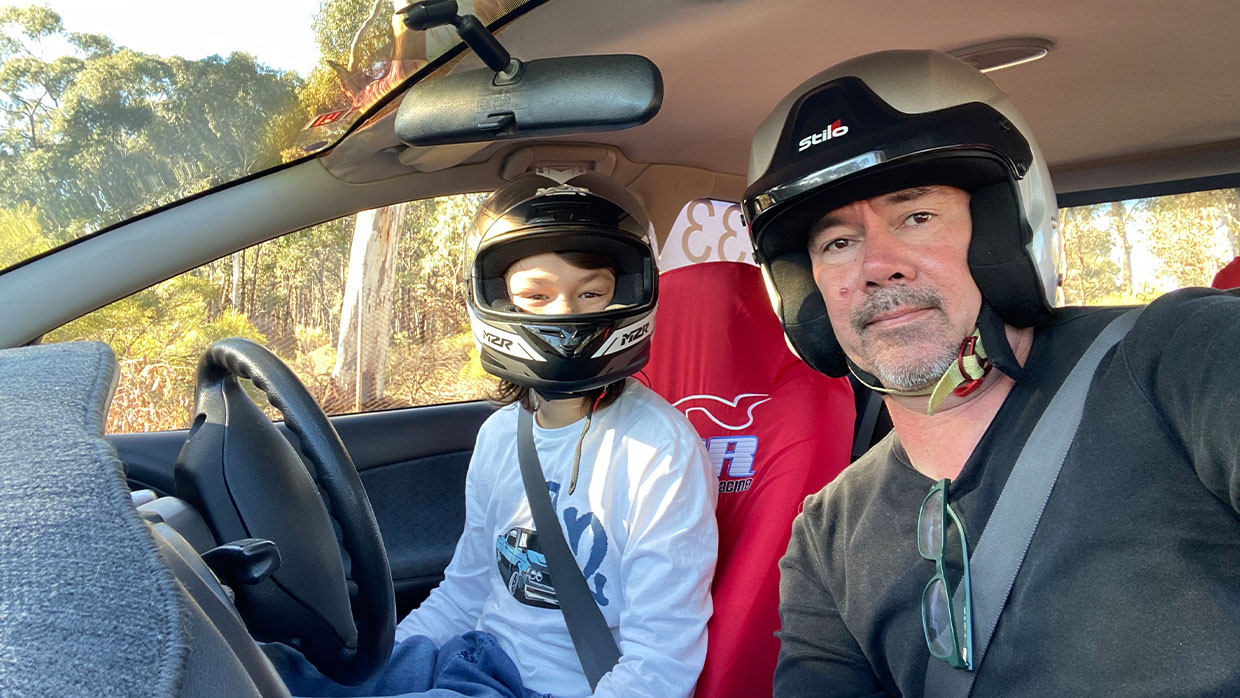
Parent guides on bookshelves offer little guidance (one presumes) about times when your 14-year-old needs performance road rubber for his Holden VT Commodore at short notice and with limited budget. Such a glaring oversight, I know…
The issue here is obvious: he’s not legally old enough to work and therefore purchase said road rubber at his age.
The kid does khanacross with a CAMS-affiliated Victorian car club. As you can from 12 years and up. Long story short, he wrangled a VT Commo at 13, has spent 18 months learning to drive flat out and usually sideways on gravel — or an approximation of — and, suddenly, his first competitive tarmac even arrived with just a week’s notice.
Thing is, his Commodore fits all-terrain tyres. Partially because of the grip and traction advantage. But mostly because the surface at his home track of Bagshot in regional Victoria burns road-going rubber to the canvas quicker than you can say Bob Jane.
Three days out from the event, I narrowly avert the horrors of Facebook Marketplace for ‘cheap steelies’ when it transpires that Chasing Cars road test editor, John Law, has a stash of BMW wheels left over from his own car club pursuits, that just so happen to match the VT Holden’s wheel stud pattern and offset. Six of them. For free.
Two days out, and converted into a surrogate panel van, the Bimmer rolling stock is loaded into the back of Santa, with room to spare.
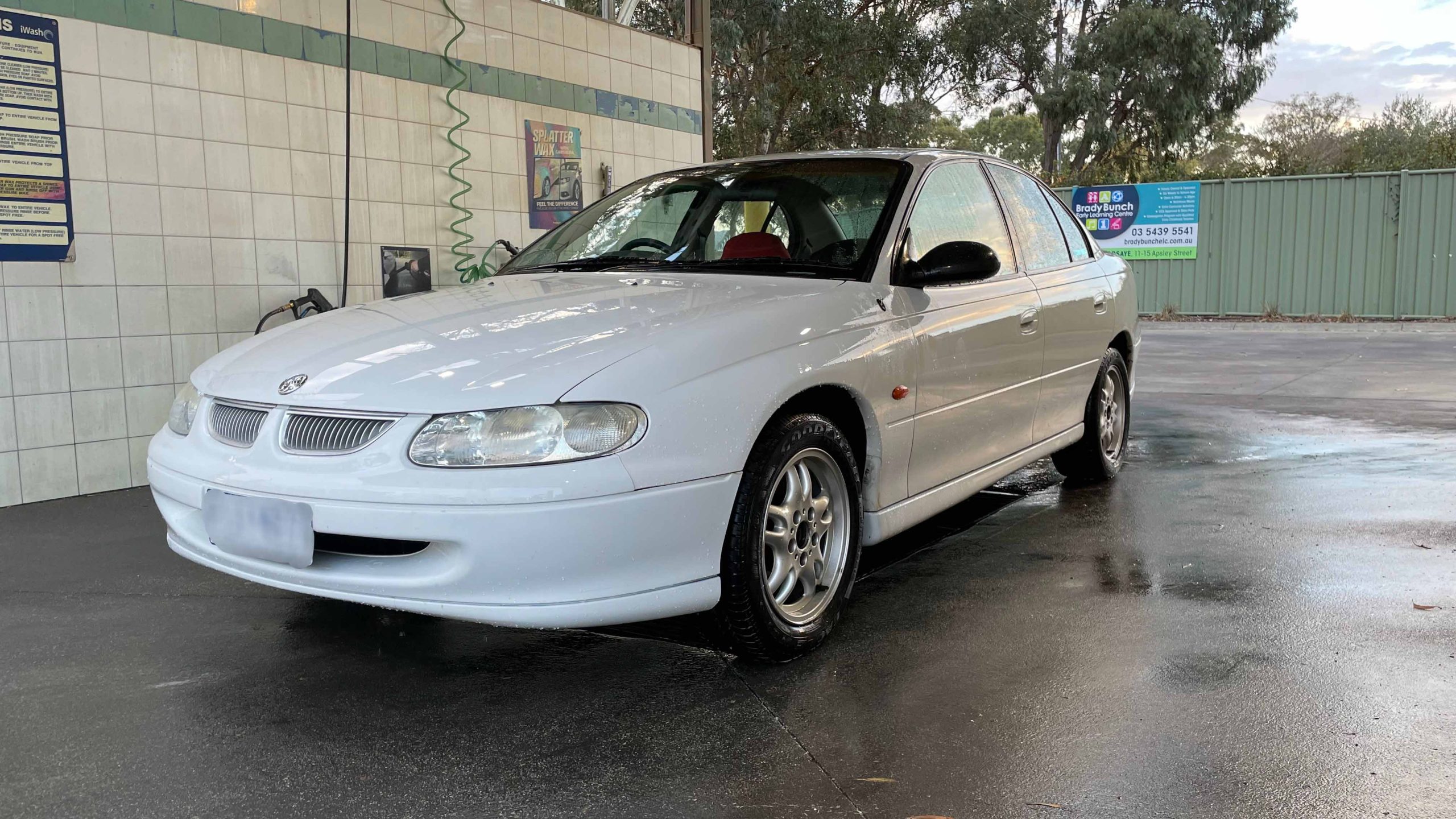
The next day, I hit the Hume south from Sydney on a nine-hour mercy run to regional Victoria, with fingers firmly crossed. A top-up in the hybrid offers almost 950-kilometres indicated per tank given it ticks along easily in the mid-sixes per hundred — on cheap E10, too — so no need to burn time with multiple fuel stops.
Light fading, the evening before the event, I arrive in Bendigo, junior and I unload the Bimmer wheels, sort them into pairs (according to tyre sizes available) and the kid mans the jack in the garage, swapping out all fours in what seems like under 30 minutes.
Miraculously, the wheels not only fit, there’s ample clearance all-round to the guards, given the car’s new 235mm front and 245mm rear tyre stagger. A quick tub at the local car wash and we head home to pack for a typical early-morning start for motorsport day.
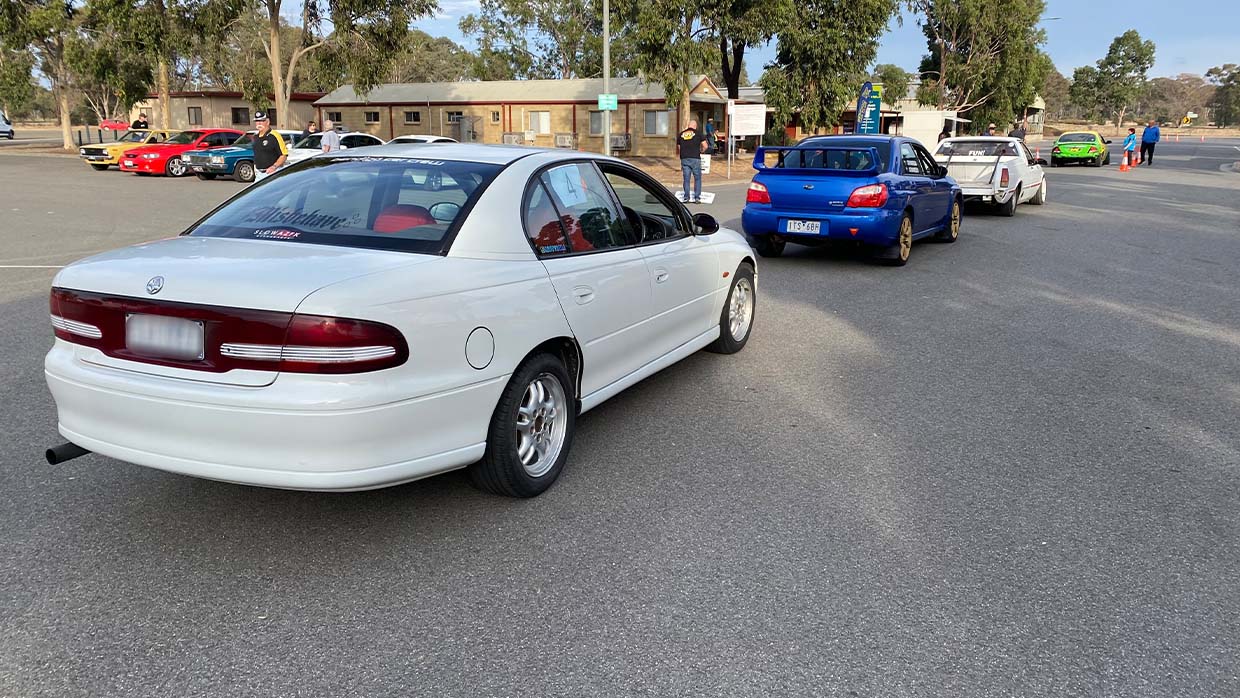
Race day, junior’s first-ever crack on sealed asphalt at full noise, is a win — not so much by the stopwatch, but from the smoke he manages to peel off the rears. And that he’s kept his VT Commodore straight and out of the scenery while doing so.
Santa also proves very handy at the most obscure of family-oriented tasks: a motorsport support vehicle. It would be the last time the Hyundai would be called into play supporting a teen’s adrenaline-filled pursuits.
The wheels worked a treat, too. Thanks Johnny! We owe you one!
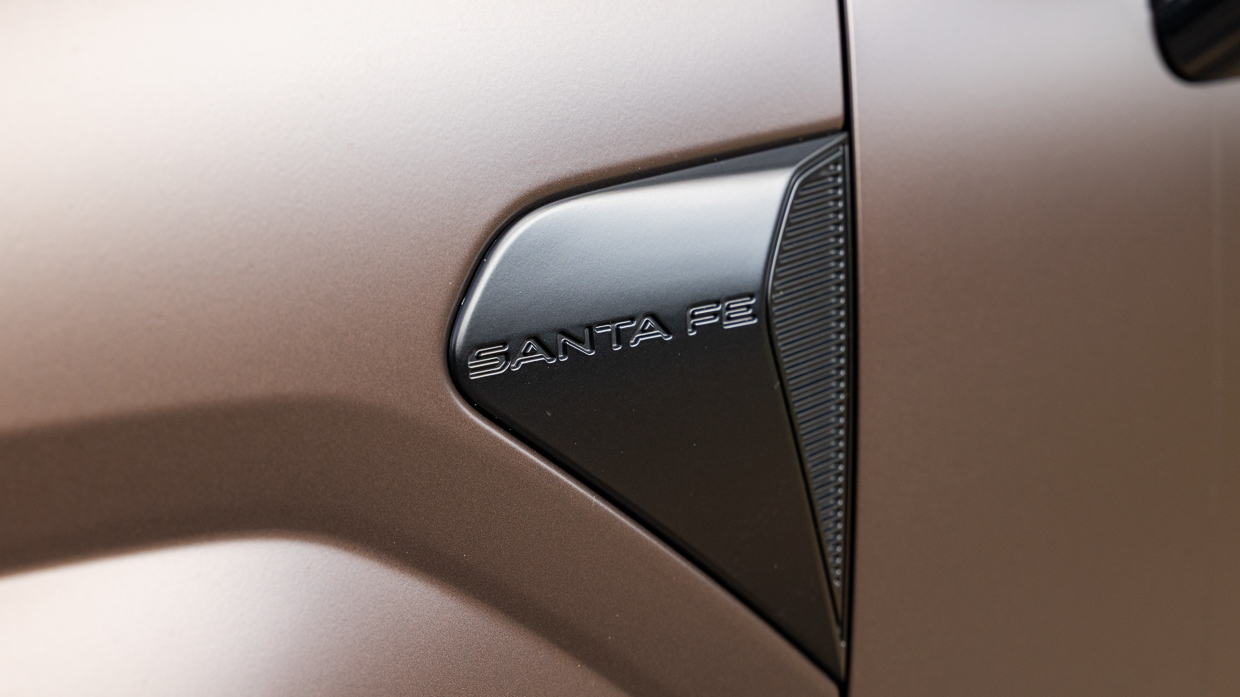
It’s on the nine-hour return trip to Sydney, free of squeaking tyres and the cabin settling into silence, that the Santa Fe’s driver annoyance…erm, I mean, ‘assistance’ systems begin to grate.
In short, the media system takes forever to load, causing a delay at every restart to defeat the overspeed warning system through the touchscreen.
Worse, the driver attention monitoring feature — which you can’t permanently switch off — bleats every time you go to change audio settings in the touchscreen or, incredulously, when watching the driver’s screen for too long…
…usually in search of why the car is bleating at you in the first place.
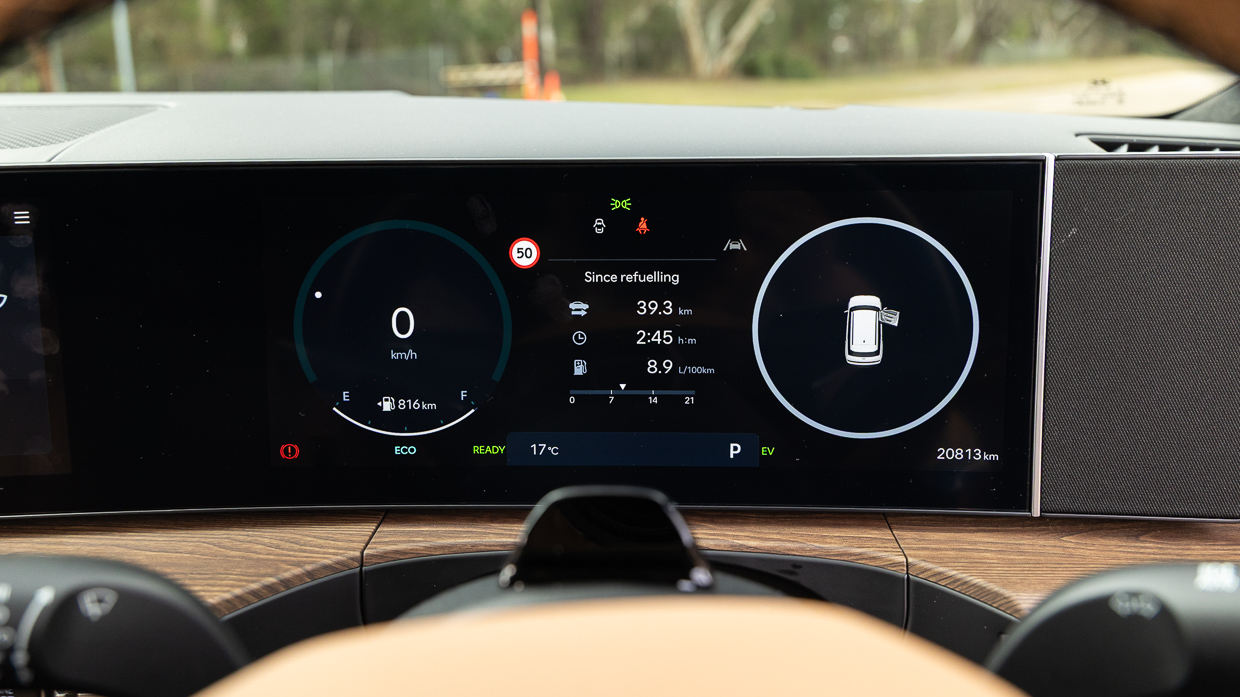
Why put fancy screens in a car when the vehicle itself reprimands you for daring to use them?
The adaptive cruise control is okay, if slow to adjust to changing conditions around the moving SUV. Ditto the lane centring system, which weaves around between the hotmix’s white lines like its pilot has had one too many long island ice teas.
Squeeze the throttle gently to accelerate under cruise control and Santa actually decelerates for some unknown reason…
These are no behaviours befitting our 2025 Car of the Year. And demand further investigation as our six-month custodianship rolls further on.
Month 1: The wrong Santa Fe?
What ever happened to Arthur, our 2025 COTY-winning Calligraphy?
Be it fortune or fate and fair or foul, somehow, we ended up with the wrong Santa Fe.
The convenient narrative is that the Santa Fe collective – a base, an Elite, a Calligraphy – fronts up to 2025 Car Of Year, wins, and then Chasing Cars grabs one of the trio off the back of the event for six months of “did we get this verdict right?” assessment. But it didn’t pan out that way.
Here’s the truth. My old long-termer, the Hyundai Tucson called Ari, was due to return to Hyundai HQ in the weeks prior to our COTY event shenanigans.
What better send off than to use the Tucson as a support vehicle for the 50-strong-competitor, week-long interstate circus? Such events need extra workhorses to ferry crew and gear off camera.
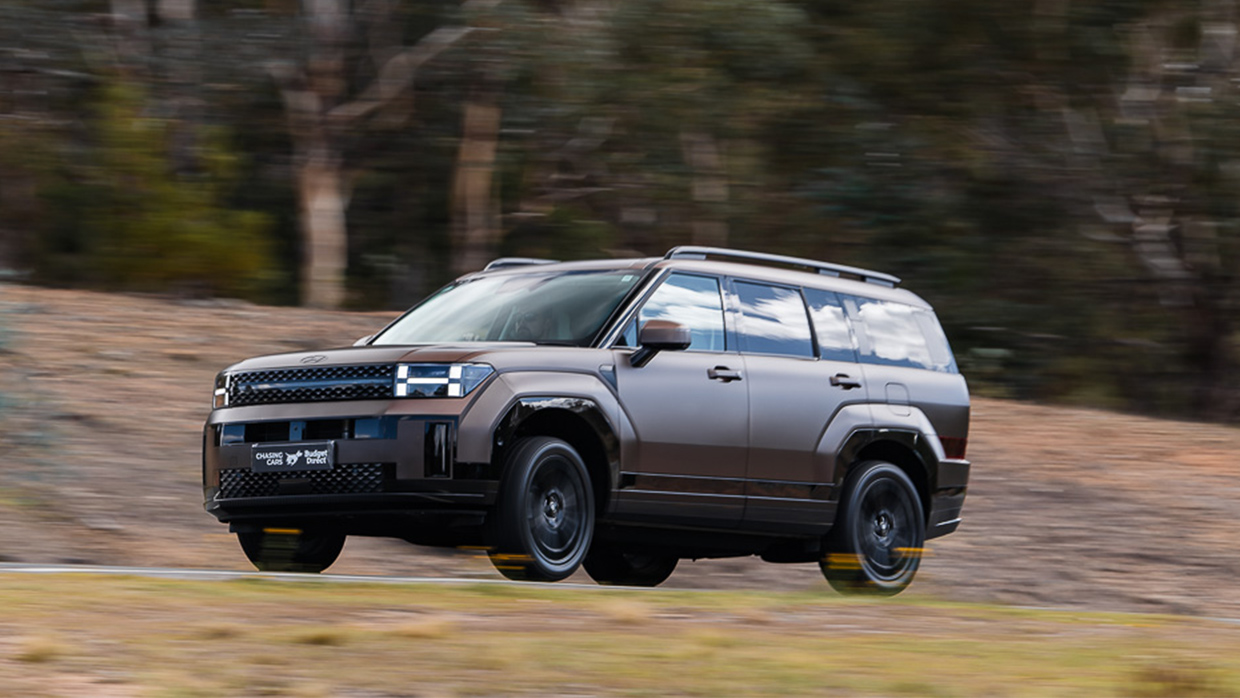
In negotiating a delayed return, we’d lined up a replacement for the Tucson: an Earthy Brass Matte Calligraphy due as a direct swap literally days after our COTY finished.
Why? Because a step up to Hyundai’s large SUV from its well-regarded mid-sizer – both using the same 1.6T hybrid powertrain – would be an interesting comparison.
So a satin brown example of the Santa Fe hybrid was locked in for the Chasing Cars long-term fleet before it won Car Of The Year.
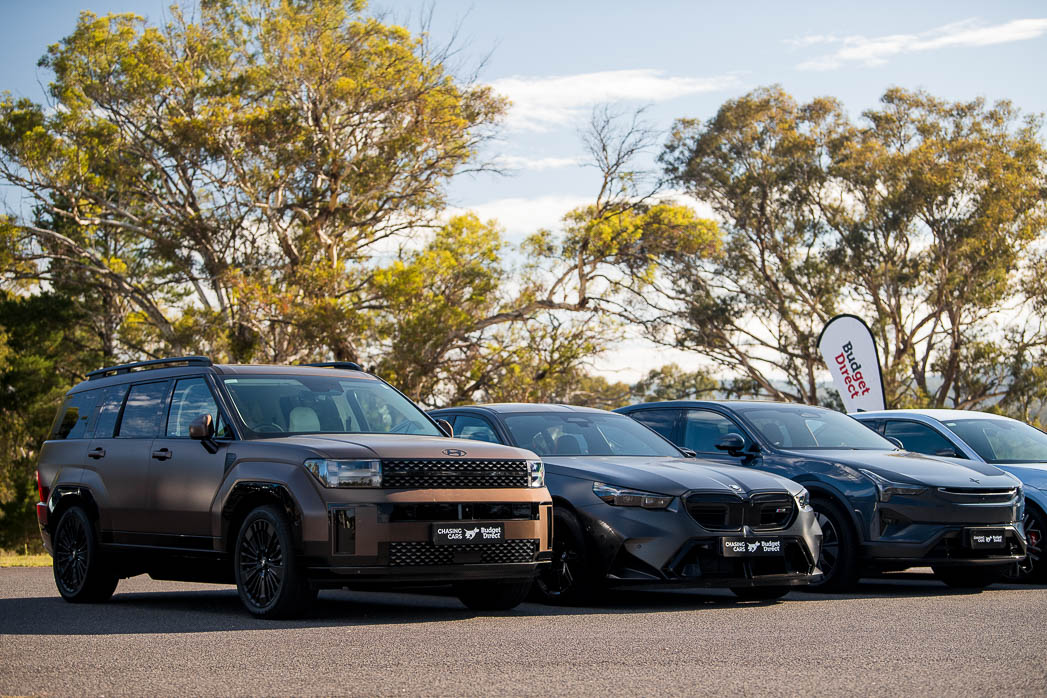
Of course, as the dust began to settle on the COTY verdict mid-event, a satin brown example of the Santa Fe hybrid was (partly) looking at taking out the overall win…and we put the obvious two and two together, didn’t we?
Our COTY winner one week would be the same vehicle to land in the Chasing Cars garage next, right? Right?
During event filming, we noticed something strange: our COTY Calligraphy had a huge dent in the roof.
Of course, you, the viewer, can’t see the damage…because we strategically shot around it to hide it. But, more concerningly, how the heck did <we> put a huge crease in the roof between the black roof rails…?
Fast forward one week and it’s time to swap our Tucson long-termer for our Santa Fe at Hyundai HQ who – at this stage of the proceedings – has no idea its large SUV has won Car Of The Year.
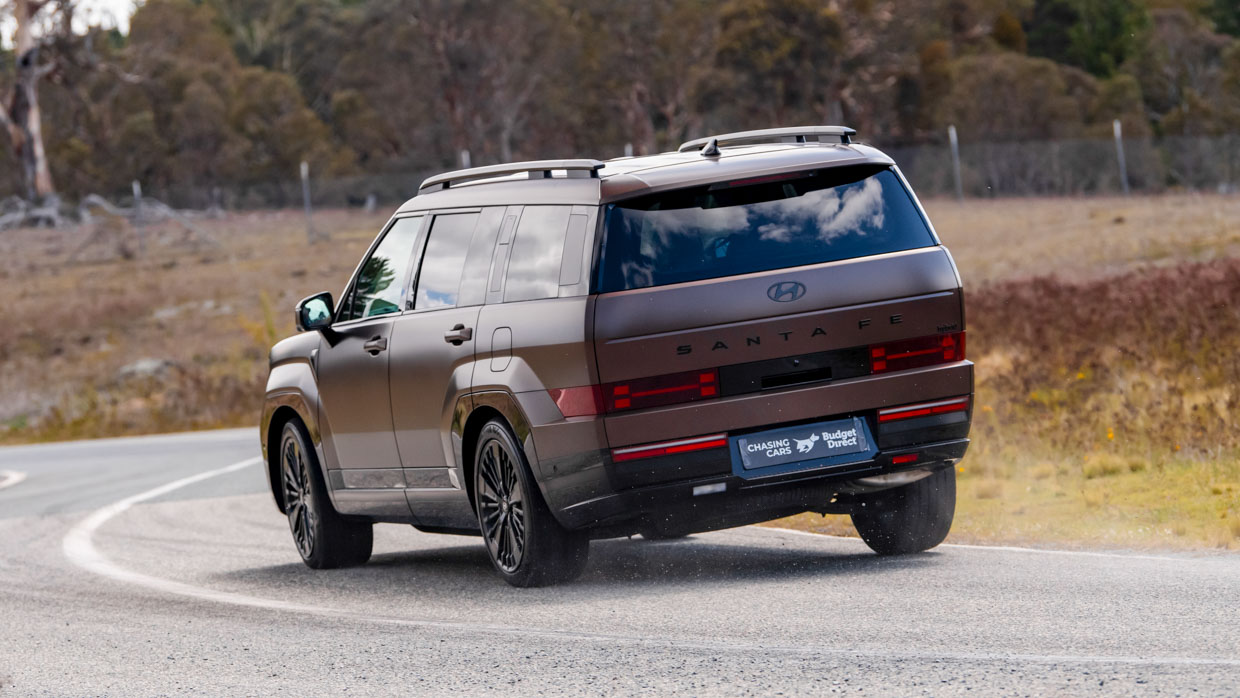
There it was, parked up, as clean as a whistle, the Earthy Brass Matte Calligraphy I’d already nicknamed Arthur in homage to Douglas Adam’s <The Hitchhiker’s Guide To The Galaxy> main character, Arthur Dent (get it?).
I approach the vehicle. I check the roof. No dent. So no Arthur. Bugger.
Turns out Hyundai had a number of semi-gloss bronze Calligraphys on fleet. And had I paid closer attention, I’d already have clocked that our COTY car had a completely different Forest green six-pew interior, not the Pecan Brown seven-pew arrangement of our new – and yet nicknamed – long-term steed.
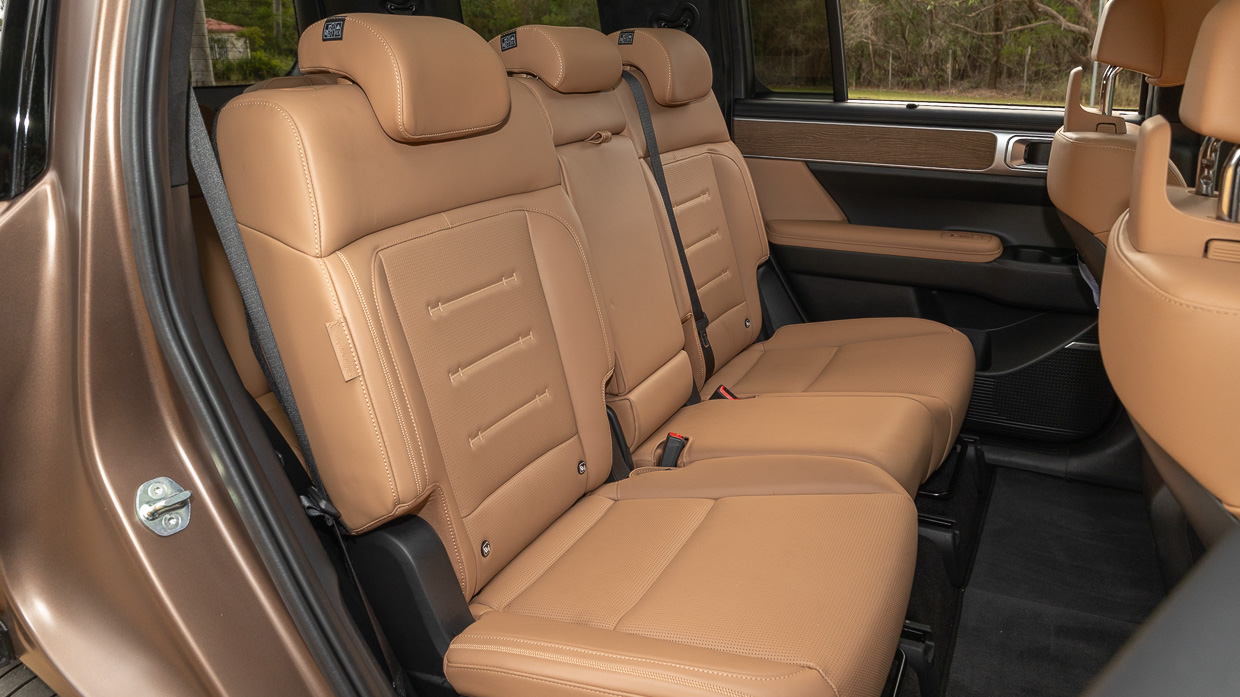
Pictured: Our Santa Fe with three-seats across the middle row, making this one a proper seven-seater
Also turns out Arthur’s dent wasn’t the fault of Chasing Cars. “Oh yeah, we did that,” explained Hyundai, without further explanation in clarifying when or how. Presumably our COTY was presently sitting somewhere at Hyundai Australia’s preferred body repairers…
So I nicknamed our Santa Fe ‘Santa’ – face-palmingly obvious, I know, but I’d already burned through a half-decent idea with Arthur and I was stumped for any alternative replacement.
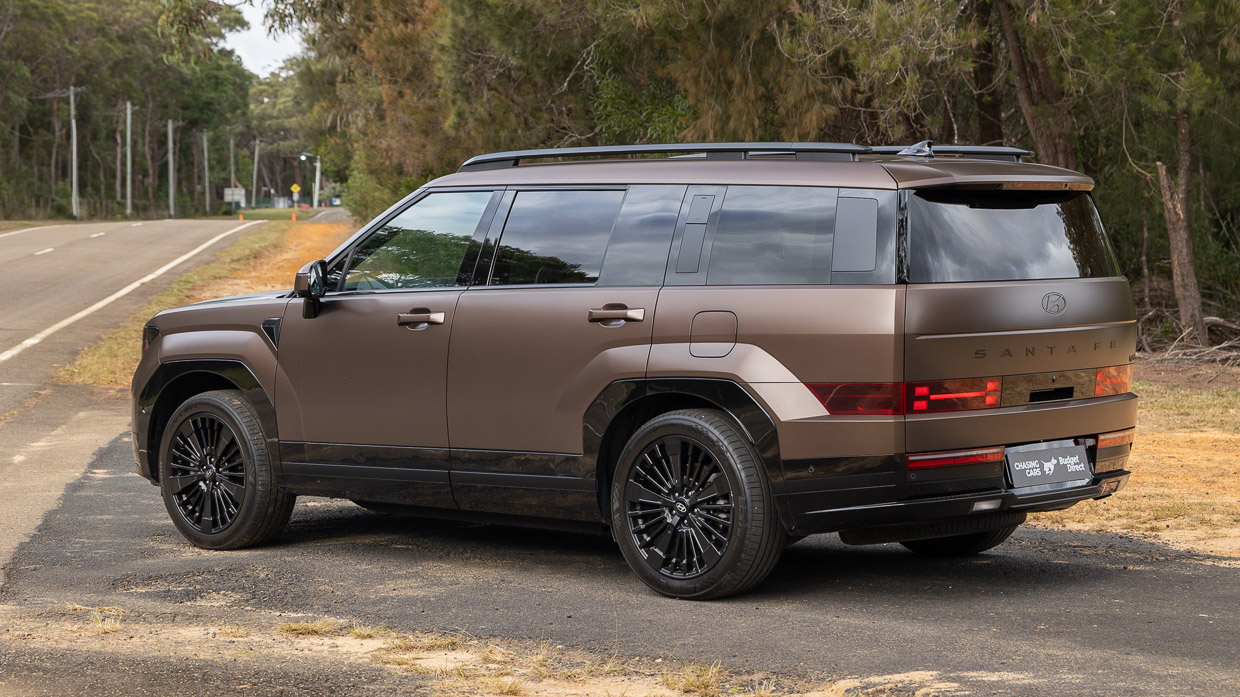
Interestingly, Santa arrives with an unprecedented 15,000km already on the odometer, and some signs of wear and tear that we’ll get into in future report updates. That’s a pretty brave move by Hyundai, because we don’t plan on returning Santa until there’s 25,000km of total mileage under its tyres.
That’ll be about as fair a long-term assessment of Car Of The Year mettle as we could hope for.
Chasing more Santa Fe?
$76,795
Details
Key specs (as tested)
Engine
Capacity
1598 cc
Cylinders
4
Induction
Turbo
Power
132kW at 5500rpm
Torque
265Nm at 1500rpm
Power to weight ratio
66kW/tonne
Fuel
Fuel type
PREMIUM UNLEADED/ELECTRIC
Fuel capacity
67 litres
Consumption
5.6L/100km (claimed)
Average Range
1196km (claimed)
Drivetrain
Transmission
Automatic
Drivetrain
All Wheel Drive
Gears
6
Dimensions
Length
4830 mm
Width
1900 mm
Height
1720 mm
Unoccupied weight
1990 kg
About Chasing cars
Chasing Cars reviews are 100% independent.
Because we are powered by Budget Direct Insurance, we don’t receive advertising or sales revenue from car manufacturers.
We’re truly independent – giving you Australia’s best car reviews.
Related articles
Skoda Enyaq 2026 review
1 month ago

With its wagon-centric Modern Solid remake, our reigning Five-Seat Car Of The Year just got better, smarter, more handsome and broader in appeal
Good points
- Solid Modern design
- Fetching, practical wagon now offered
- Euro build at Chinese price points
- On road manners
- Simply clever touches
Needs work
- No dual-motor yet
- Clumsy regen UI
- Pricey options pack for adaptive suspension
- Wooden brake feel
- Minor powertrain updating
If the Enyaq version one was Skoda’s gymnastic vault into fully electric motoring, the just-launched V2 is the Czech brand’s local arm firmly sticking the landing.
Let’s explain. Enyaq launched locally last year in mid-lifecycle, big-battery form, as an appealing rear-drive Sportline coupe that nabbed our 2025 Five-Seat Family Car of the Year award and as a pricey ($84K) yet likeable dual-motor Coupe RS that was, in as-tested tennis ball yellow, possibly the ugliest car of the year thus far.
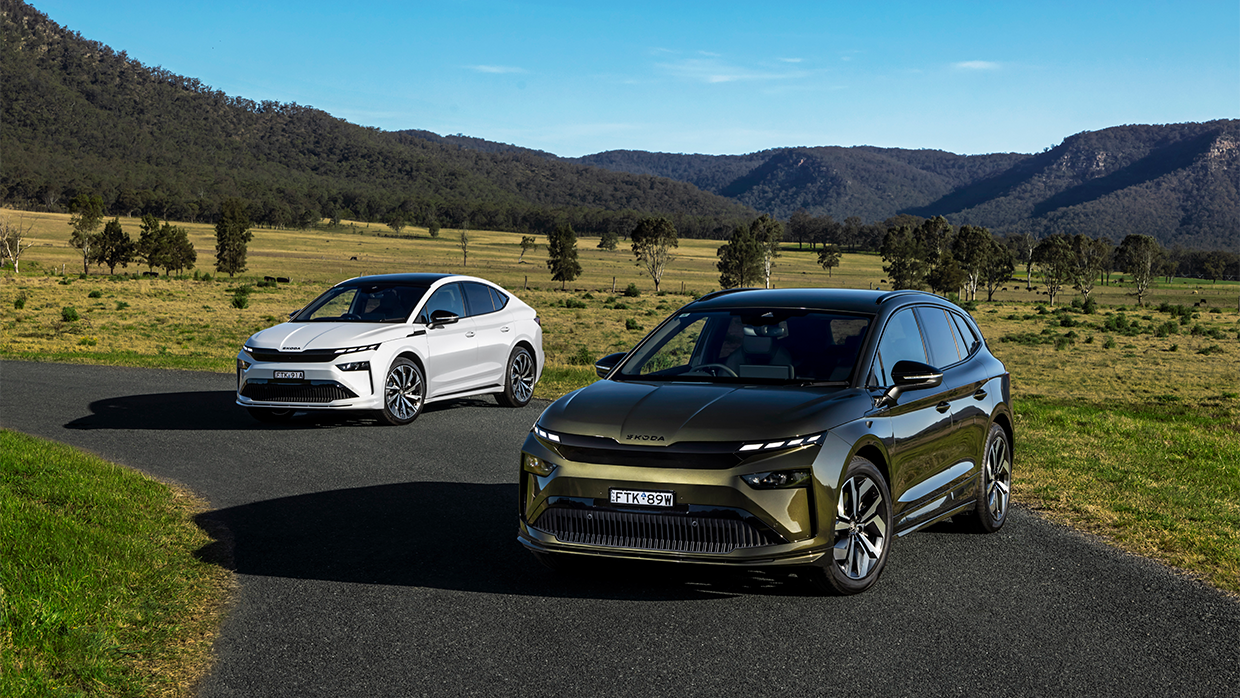
Then, just weeks ago (at the time of writing), Skoda debuted its slick Modern Solid design language in Enyaq’s smaller-bodied EV twin, the Elroq ‘hatch’, to double its electric lineup.
It foreshadowed the arrival of Enyaq 2.0, the Modern Solid restyling literally transforming the model’s looks and appeal of Skoda’s only all-important (and all-electric) mid-size SUV. With it comes the subjectively better looking wagon body style to what was a coupe-only lineup in pre-facelift, atop its award-winning if mostly carryover MEB underpinnings.
More? A price-busting 60 Select trim is set to join the Enyaq (and Elroq) rank(s) in the coming months, dropping the Euro designed and built all-rear-drive electric SUV to a super-keen $50,990 entry.
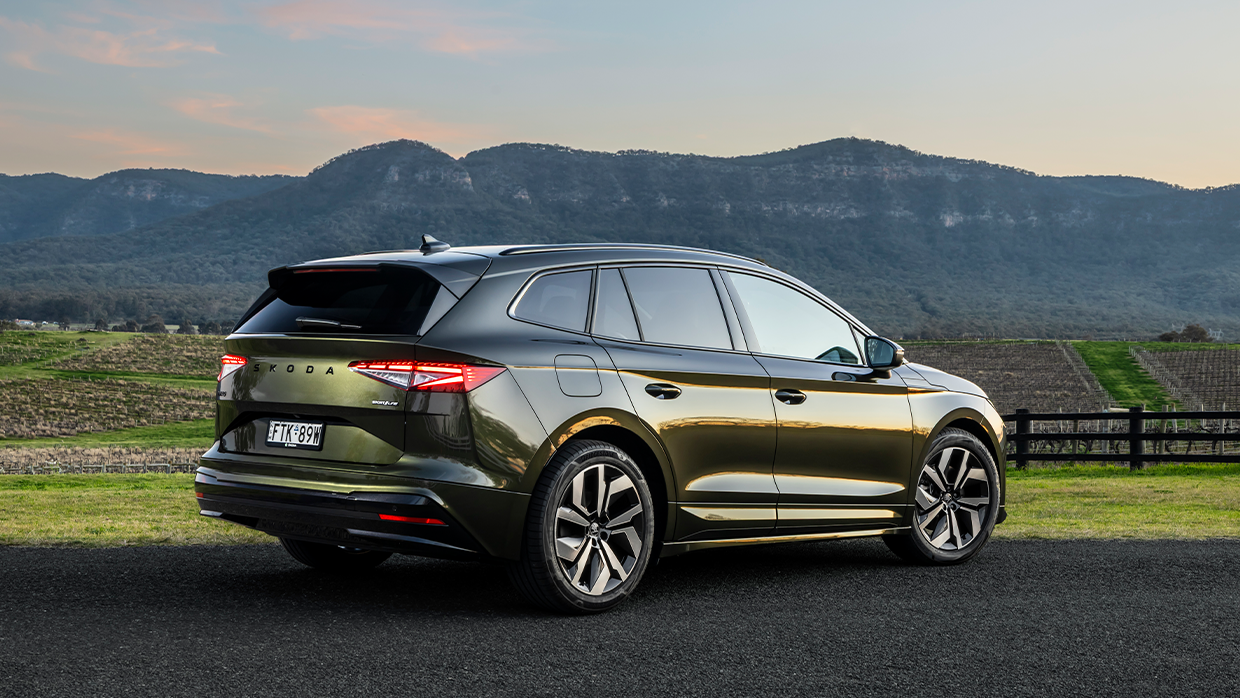
And the go-faster dual-motor RS is set return by Q1 2026, this time in a choice of either a coupe and a wagon.
In one facelift, what was formally the oddest model in the Skoda line-up now appears more handsome, more broadly appealing, and more palatable to more EV buyers, a genuine European disrupter pitched and priced directly — and viably — against Chinese-sourced stalwarts from Tesla, Kia, BYD and others.
And this from a brand that, unlike some logical nemeses, has been slogging away as a ‘challenger brand’ in Australia for almost two decades now.
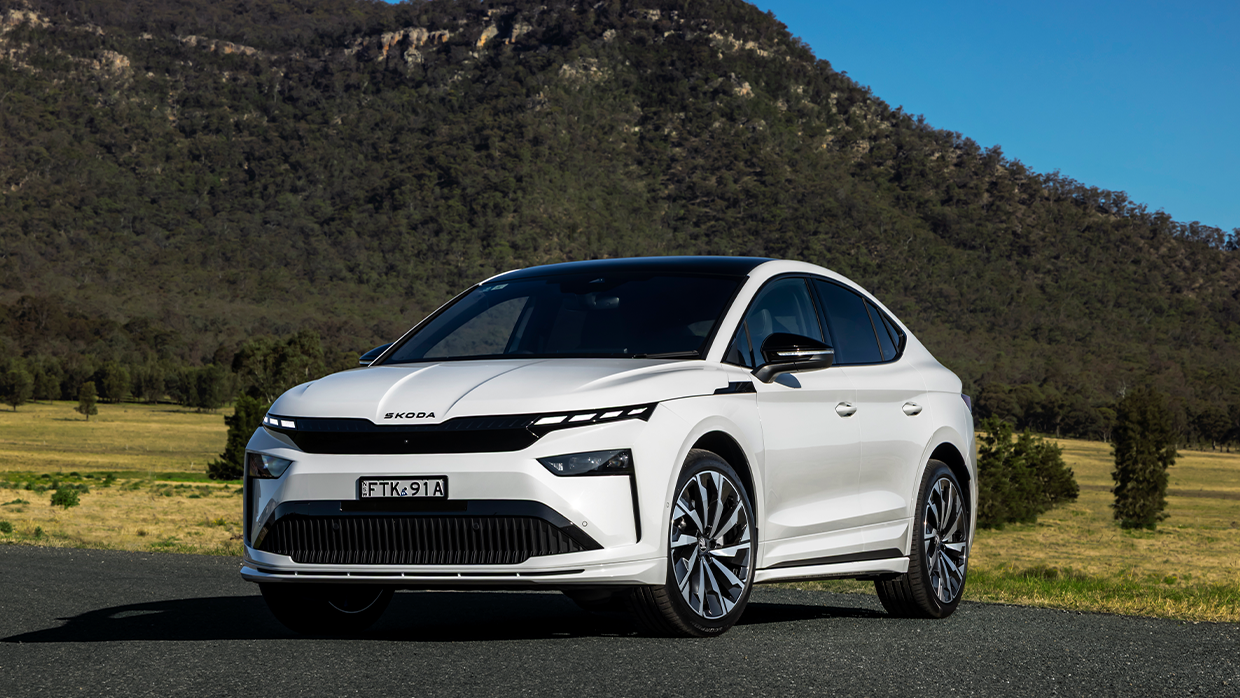
But while Skoda Australia appears to have stuck the EV landing, is this revamped performance good enough to warrant gold medal consideration.
What are the Enyaq’s features and options for the price?
While a full lineup breakdown is covered off in our pricing and specs story, the Skoda Enyaq effectively launches in three grades across two body styles and with a pair of key options packages. These don’t include the yet-to-be-detailed RS versions coming in Q2 2026.
The new wagon-only entry 60 Select grade drops the entry price of Enyaq down to $50,990, or $54,990 driveaway. It features a 150kW and 310Nm single rear motor paired with a 59kWh net (63kWh gross) battery and combined range claim of 410kms WLTP.
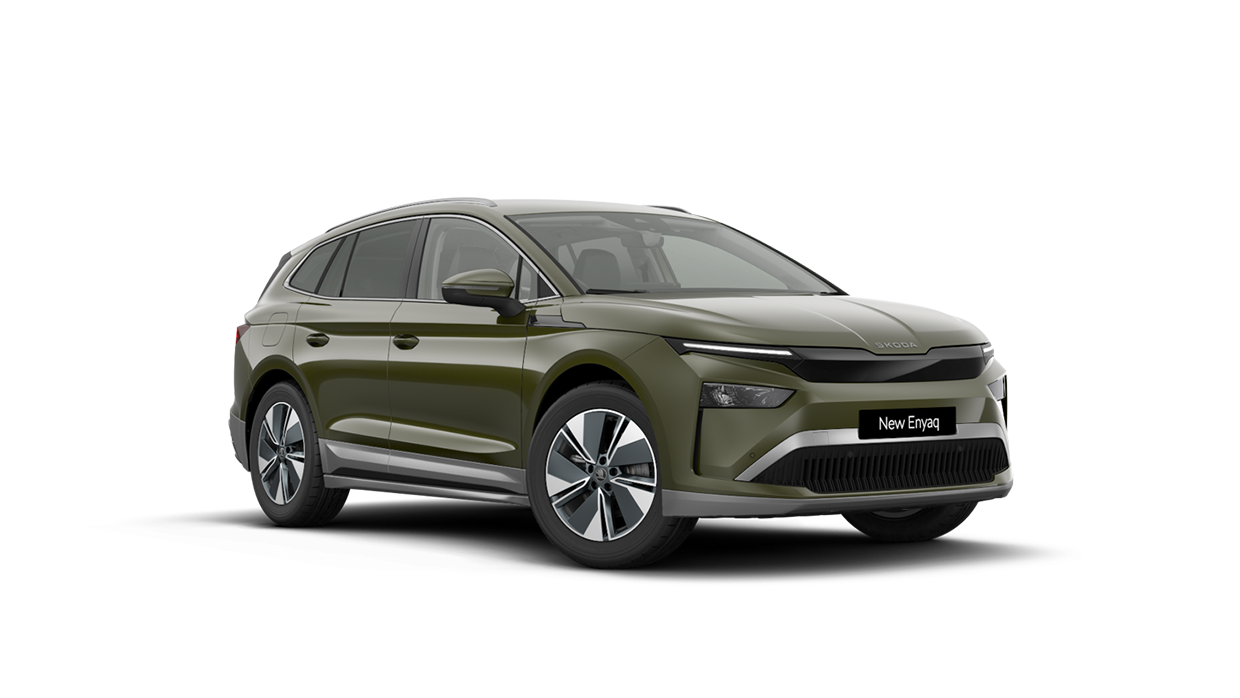
Standard 60 Select features include:
- 19-inch alloy wheels
- LED exterior lighting
- Heated/power-folding mirrors
- Front and rear parking sensors
- Adaptive cruise control
- Passive suspension
- Mechanical cloth and leatherette front seats
- Front seat and steering wheel heating
- 5.3-inch digital driver’s screen
- 13.0-inch touchscreen media
- Wireless Apple CarPlay and Android Auto
- Wireless phone charging
- 4x USB-C outlets
- Three-zone climate control
- Hand-free powered tailgate
- Umbrella in the door
A Signature package ($6000) exclusively for the 60 Select grade adds augmented reality HUD, Canton 12-speaker audio, Matrix LED headlights, rear sunshades, rear side airbags, a powered driver’s seat and more, while 20-inch wheels bring an added cost ($1000).
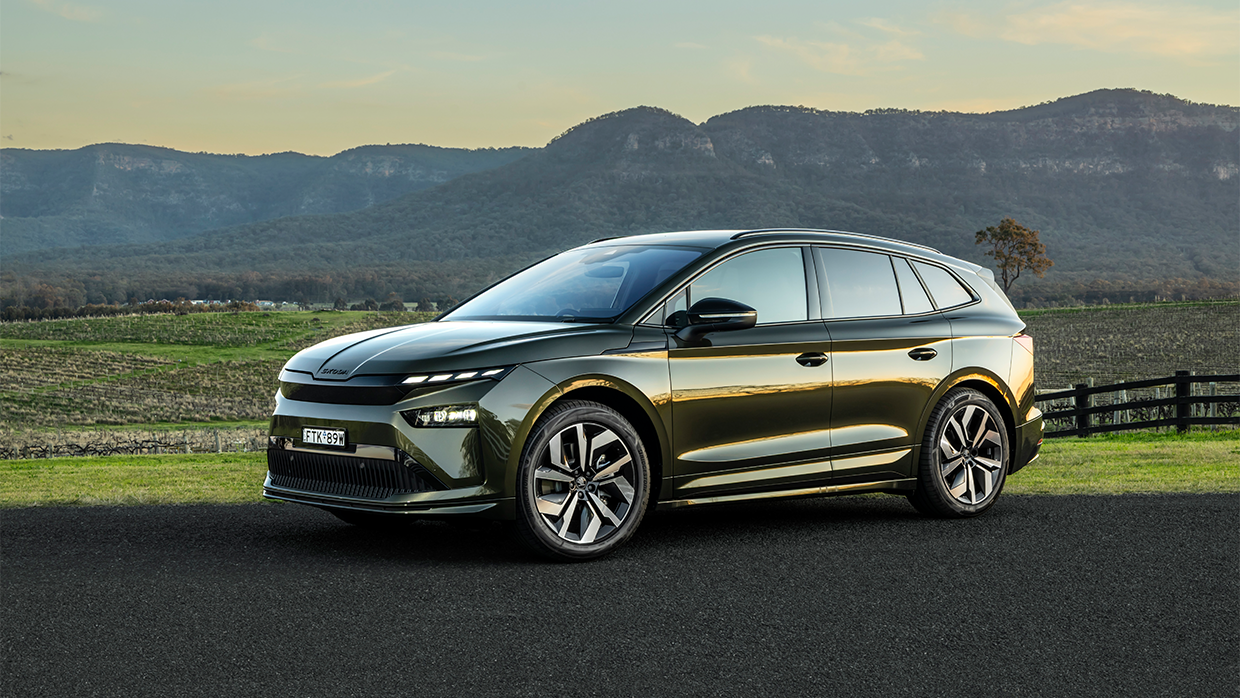
The ‘core’ variant — and expected volume-seller and our primary test subject here — is the 85 Sportline Wagon at $59,990, or $63,990 driveaway. It carries over the rear-drive 210kW/545Nm powertrain with an 77kWh net (85kWh gross) battery and combined range claim of up to 547km WLTP.
Standard 85 Sportline features include:
- 20-inch alloy wheels
- Sportline exterior styling w/ gloss black
- Matrix LED headlights, ‘premium’ LED tail lights w/dynamic indicators
- Progressive (variable) steering
- Electric/power lumbar front ‘sports’ seats
- Paddleshifter flat-bottom wheel
- Two-row outboard seat heating
- Suedia and leatherette trim
- Headed windshield
- Eight-speaker 100-watt sound
An Ultimate pack ($5000) bespoke for Sportline grade brings augmented reality HUD, 635-watt Canton 12-speaker audio, ‘area view’ camera, intelligent parking assist, 21-inch alloy wheels and Dynamic Chassis Control variable suspension that, sadly, can’t be optioned separately.
For this variant, a glass tilt and slide roof is available ($2000).
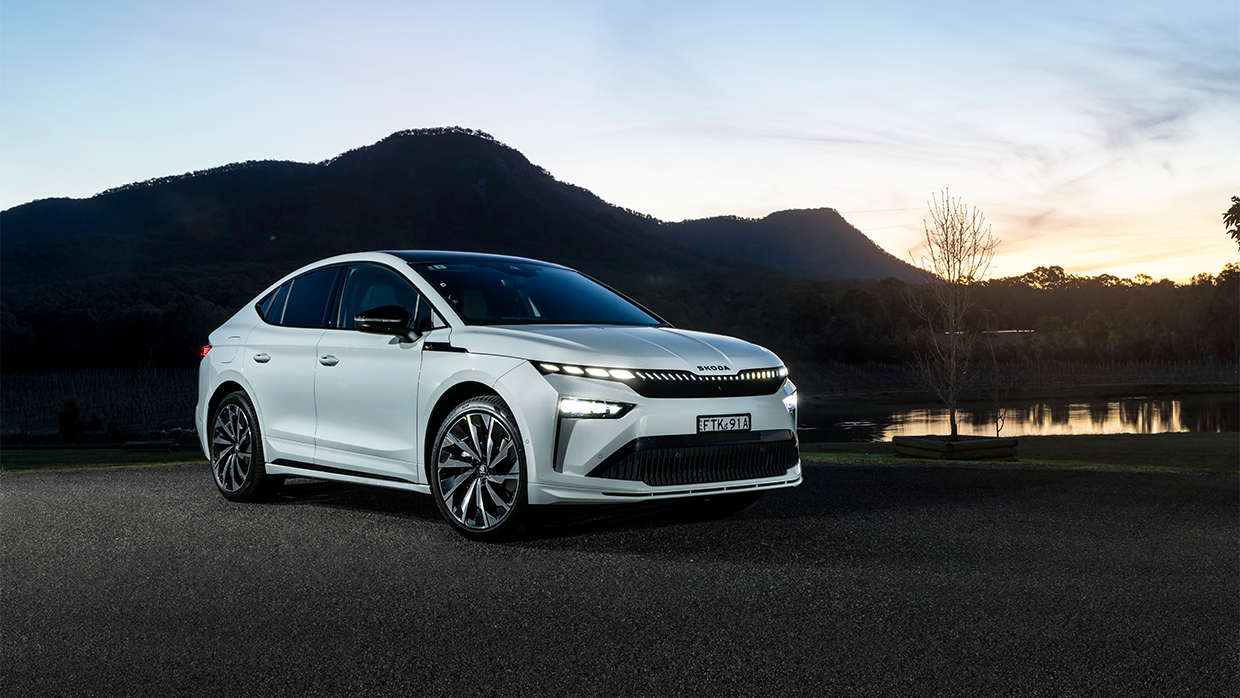
A sole 85 Sportline Coupe variant essentially mirrors the wagon spec while bundling in Ultimate pack features for $65,990 list, or $68,990 driveaway.
A choice of six colours for Select expands to seven for Sportline, with rich Velvet Red Premium Metallic the only hue demanding an upcharge ($770).
With the 60 Select not due to release for a couple of months after the local launch program — and none available to sample — our review is wholly centred around impressions of the 85 Sportline in a variety of guises.
How does the Enyaq 85 Sportline drive?
The $60K question — give or take a tenner — for our drive of new Enyaq is whether it delivers a “sophisticated, mature…calmly competent” manner that helped the old version clinch our Five-Seater Car of the Year award, or whether it’s inherited the strange ride and braking disjoint of its newly baked Elroq twin.
The answer is: very much the former.
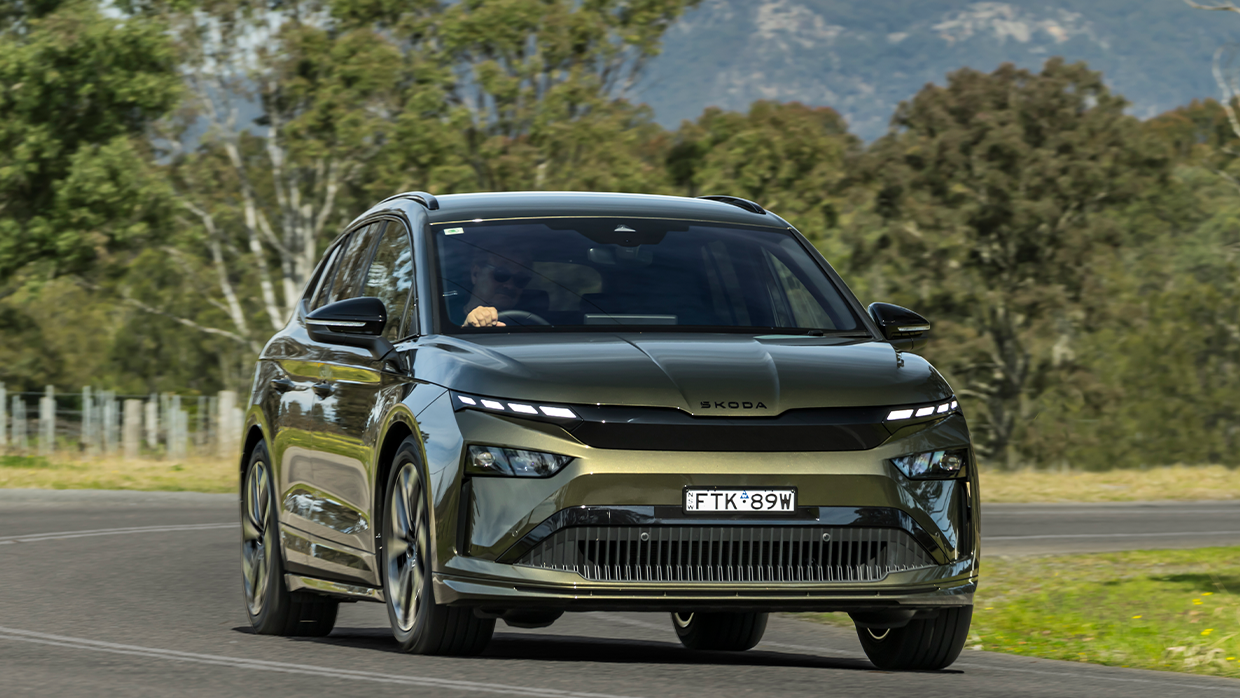
Here’s the nutshell. Be it wagon or coupe, the revised Enyaq 85 Sportline feels like a polished, well-resolved, thoroughly honed European petrol car…with added near-silent electric thrust.
It’s fluid and familiar, balancing shades of sportiness with ingrained core comfort in a package that’s wholly cooperative and predictable. And it all centres around the ride and handling balance.
Unlike passive-only Elroq the, Enyaq fits a choice of regular passive or 15-way adaptive suspension — aka, Dynamic Chassis Control — that’s standard in the flagship Coupe or optional as part of the wagon’s ($5000) Ultimate bundle. It’s the latter we try first, along a route from Hunter Valley to Wollombi, across some of New South Wales’ most pockmarked roads.
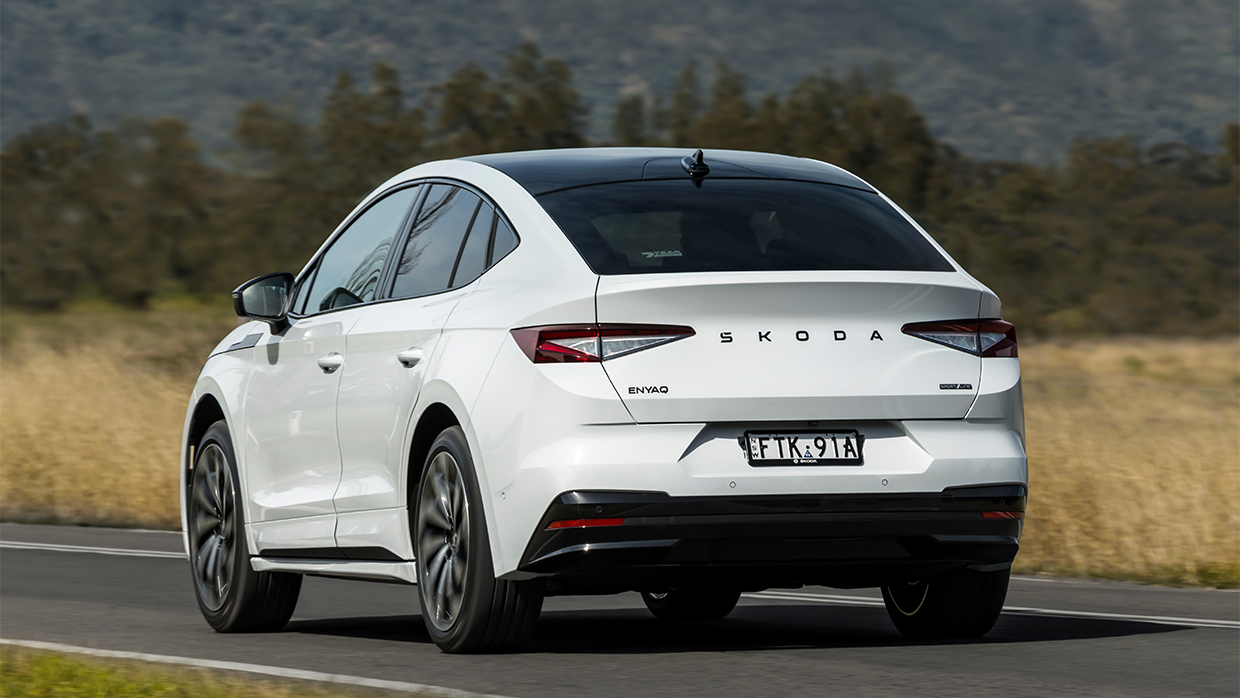
Even on 21s, the DDC-specc’d Enyaq nearly smothers all road acne without flustering. We’ll take the wallowy body control as a fair trade, though it’s easy to dial in just enough chassis tautness within the adaptive dampers 15 progressive steps. The middling settings of its range is perfect.
The wonderful variable ride is complemented with genuine driver connection, especially through the steering that’s weighty yet naturally fluid and direct. Meanwhile the brakes, which are a slightly complex blend of disc front/drum rear with adaptive regen, still lack a touch of bite and assistance at low speed, but are noticeably better than Elroq’s.
Wollombi to Mount White takes in the fast-flowing Great North Road, a biker’s favourite that’s particularly daunting to wet and changing conditions, this time in an 85 Sportline wagon on passive suspension.
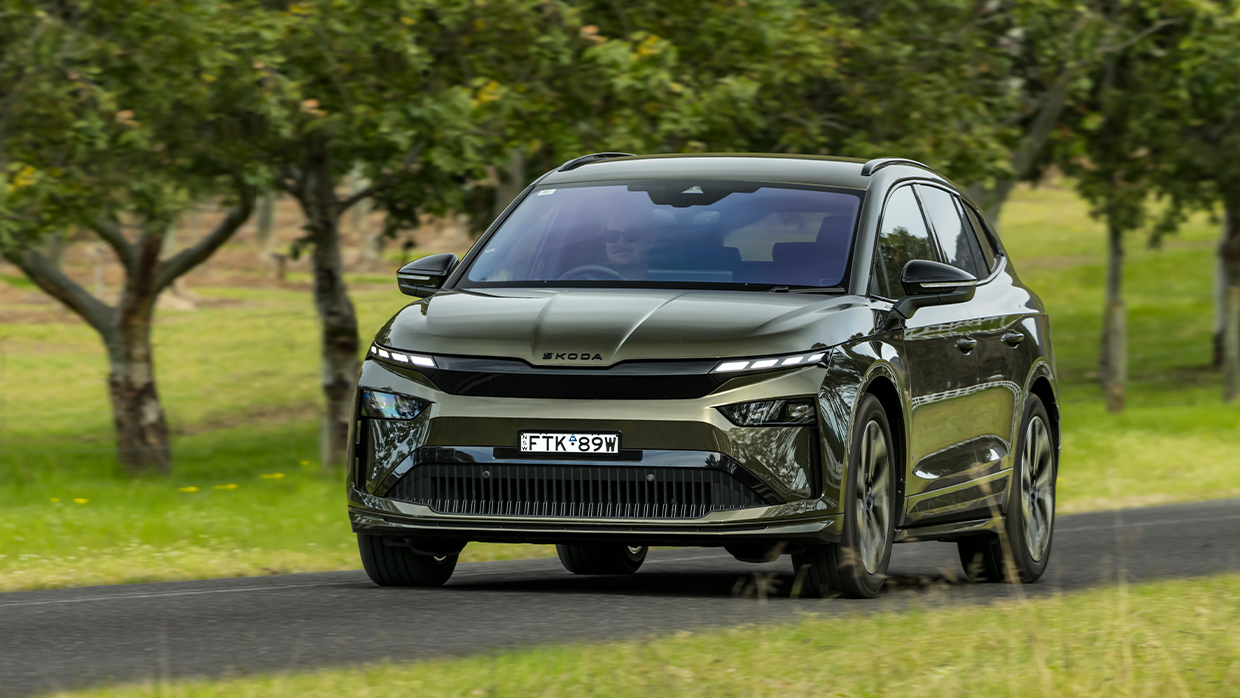
There’s bona-fide engagement, and more than a few shades of that signature Skoda Euro-sport character, in the wagon’s dynamic manner. It’s not exactly lithe — a circa 2.2-tonne weighbridge ticket sees to that — but there’s an innate and responsive manner to the wagon, which grips up surprisingly well despite the lumpy surface and wet conditions.
When the rear-driver’s chassis does shimmy, there’s a keen balance across the axles that anchors faithful cooperation with the driver, with enough slip window in the stability control to allow some fun while keeping proceedings firmly within the safety net.
Key to its fine engagement is power and torque delivery from the rear axle — right-pedal response is progressive in normal drive mode and firm without being unruly or peaky in sport. A testament to its innate athleticism is that it can be driven on the throttle with gusto, even at its weight, in the wet, on a slithering course.
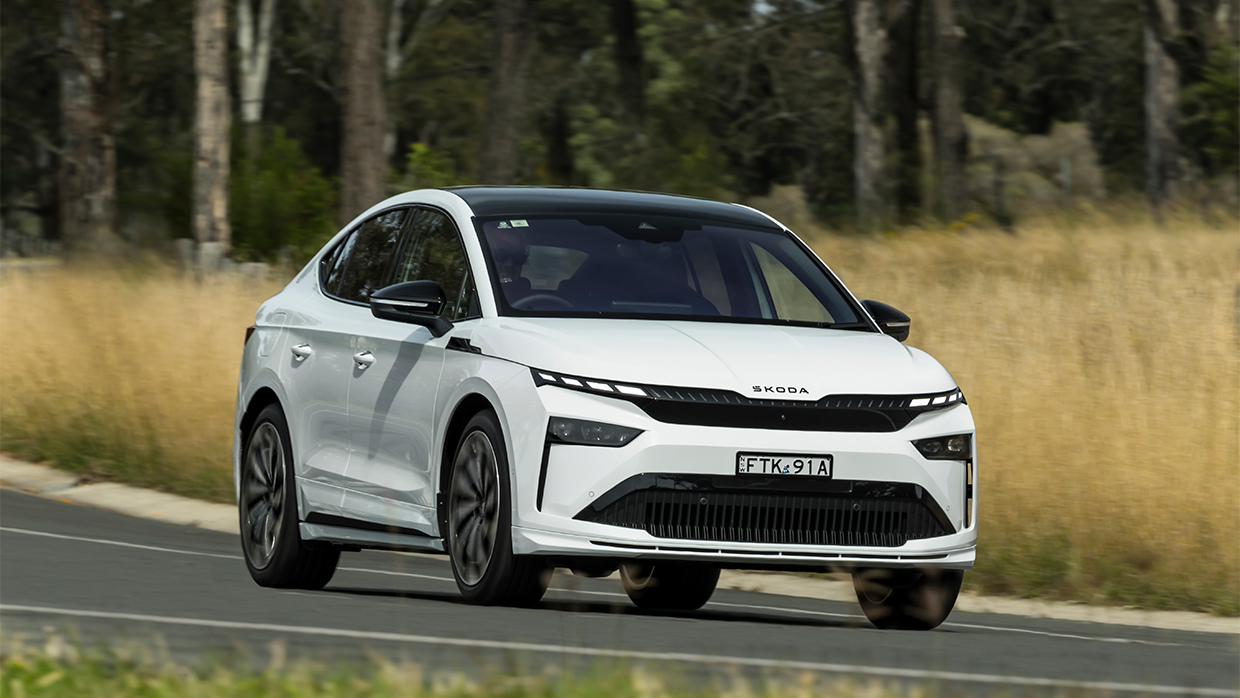
A back and forth between the two suspension formats (and both wheel sizes) through to dry running from Mount White to Hornsby via the famed Old Pacific Highway, strongly suggests that both types are very good and equally well sorted. The passive set-up, while firm, brings a convincing blend of body control and compliance that very nicely struck indeed.
Other facets? Bar switching off the enthusiastic active lane keeping, the Skoda is absolutely free of driver aid annoyances. It’s just as well sorted in the active systems’ calibrations department as you’d expect a fine European machine to be.
Downmarks on the road? There are only a few. The augmented reality feature in the head-up display — which we couldn’t get working in Elroq — functioned as described in Enyaq, though looming arrow and distance instructions projected into the windscreen isn’t the usability leap some might have you believe.
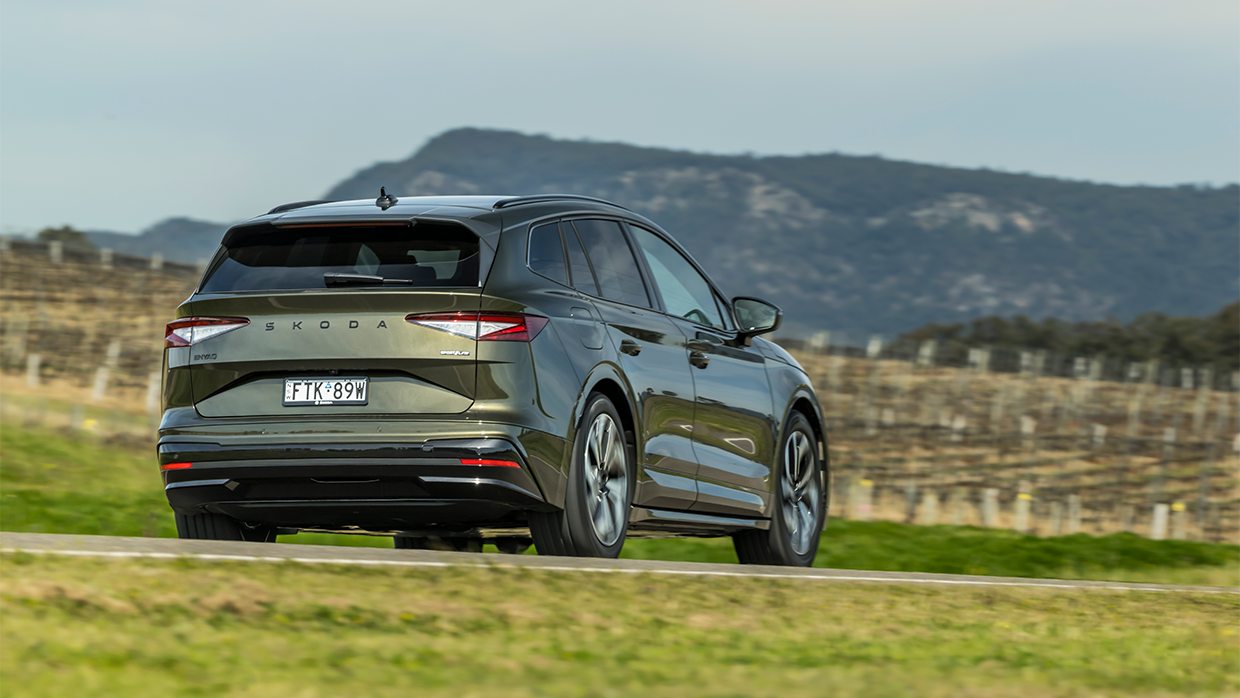
Elsewhere, the regen adjustment user interface — via paddles in D for drive or B for braking on the drive selector, but not in tandem — is less intuitive than it ought to be.
What is the Enyaq 85 Sportline’s interior and tech like?
Before (literally) diving in, the paradigm shift from coupe only to a predominantly wagon-based line-up is a great one. Not only does the wagon offer more usable boot space — 15 litres more (585L) as five-seater, 100 litres more (1710L) with row two stowed — it subjectively looks more natural and handsome in styling than the coupe.
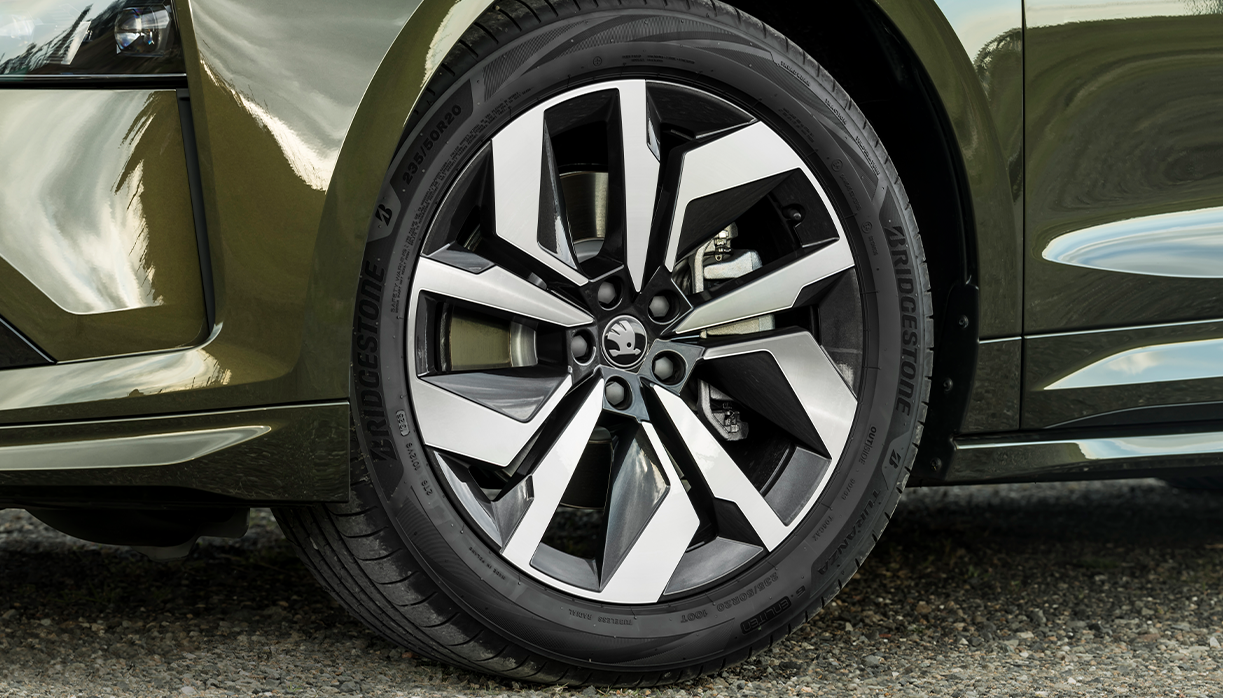
To your reviewer’s eyes, Enyaq looks better still on 20s — the 21s add a Hot Wheels-like caricature effect to the narrow hipped, tall roof proportions. In the metal, the new Olibo Green metallic paint is stunning.
Unlike the Modern Solid exterior revamp, the Enyaq interior is largely unchanged and carried over, and virtually a dead-ringer for the smaller bodied but otherwise technically twinned Elroq that’s also just been launched locally.
So it’s the same balance of freshness and familiarity with the same organically curvaceous dash fascia in a pleasingly slick and straightforward design. The functionality and usability is oh-so ICE-like ought to make the transition to electric motoring easy for new EV buyers.
But where this properly midsize Czechian-built SUV impresses most is the sense of premiumness. And mostly down to the impressively upmarket look and feel of the materials used and Skoda’s deft hand in blending them into a theme. It’s all soft touches and satin sheens in all the right places.
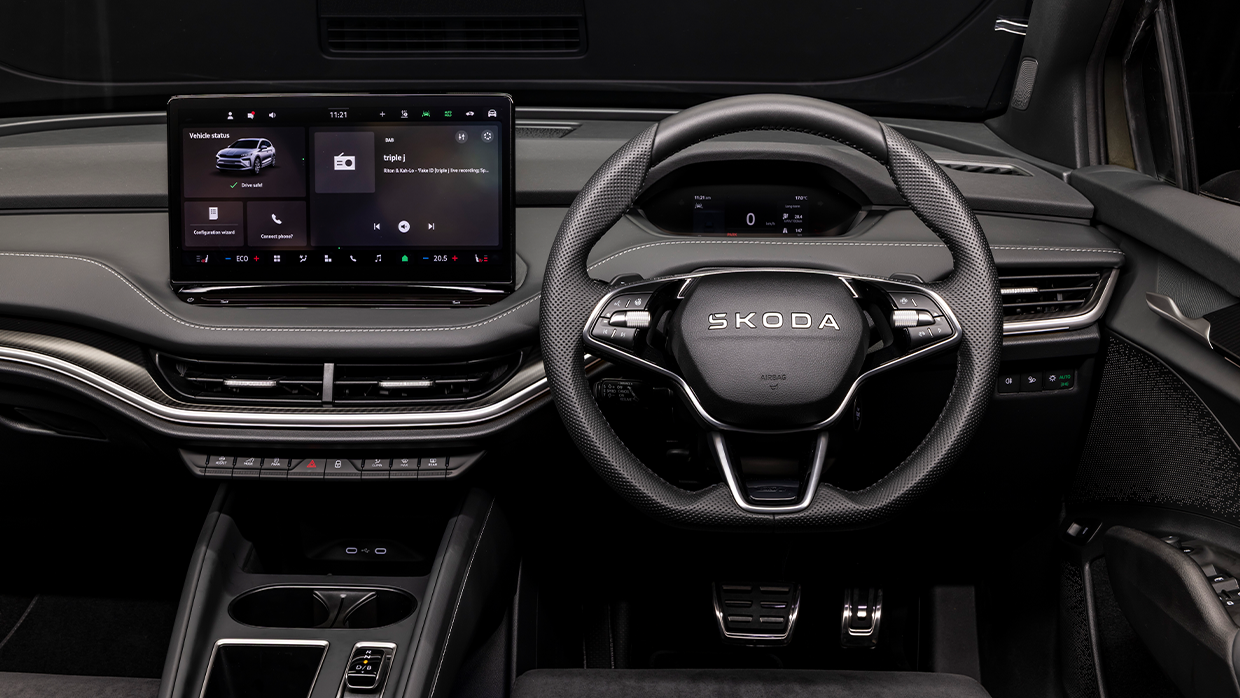
Like Elroq, the new look S-K-O-D-A wheel with ‘classic’ roller controls frames the small digital driver screen neatly, while versions with head-up displays have an odd black ‘shield’ strip the looks like another display but, instead, seems placed to hide the HUD hole in the dash top from the driver.
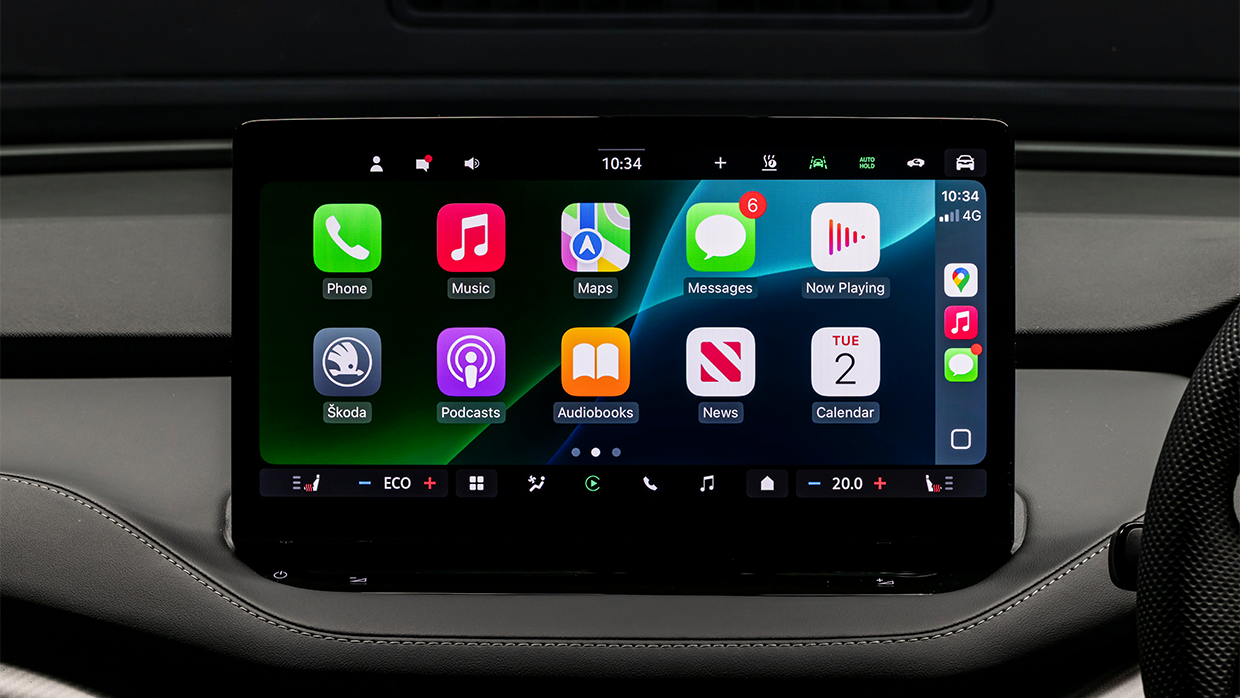
The floating 13.0-inch touchscreen is fine enough, with a handy permanent HVAC strip set low and customisable shortcut icons located high in its bright, quick responding touch screen. Being able to preset auto time-of-day activation for the aircon is handy, and thankfully, unlike Teslas, wireless Apple CarPlay or Android Auto connectivity anchors infotainment.
The Sportline seats (and the wheel for that matter) are pleasingly Euro: tactile and ergonomically sound, blending comfort and purpose nicely. There’s a pleasing resolve to the cabin, be it the placement of handles and storage cubbies — of course, flocked — and coloured stitching helps the cabin theme just avoid grey washout dullness.
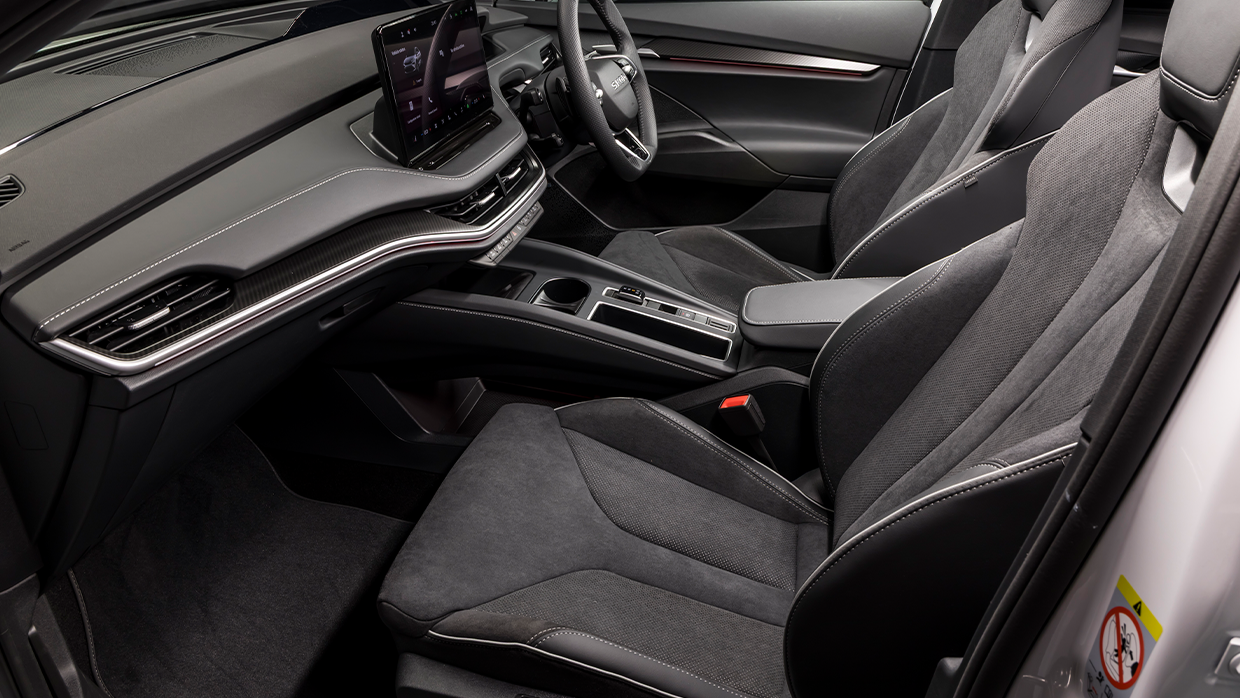
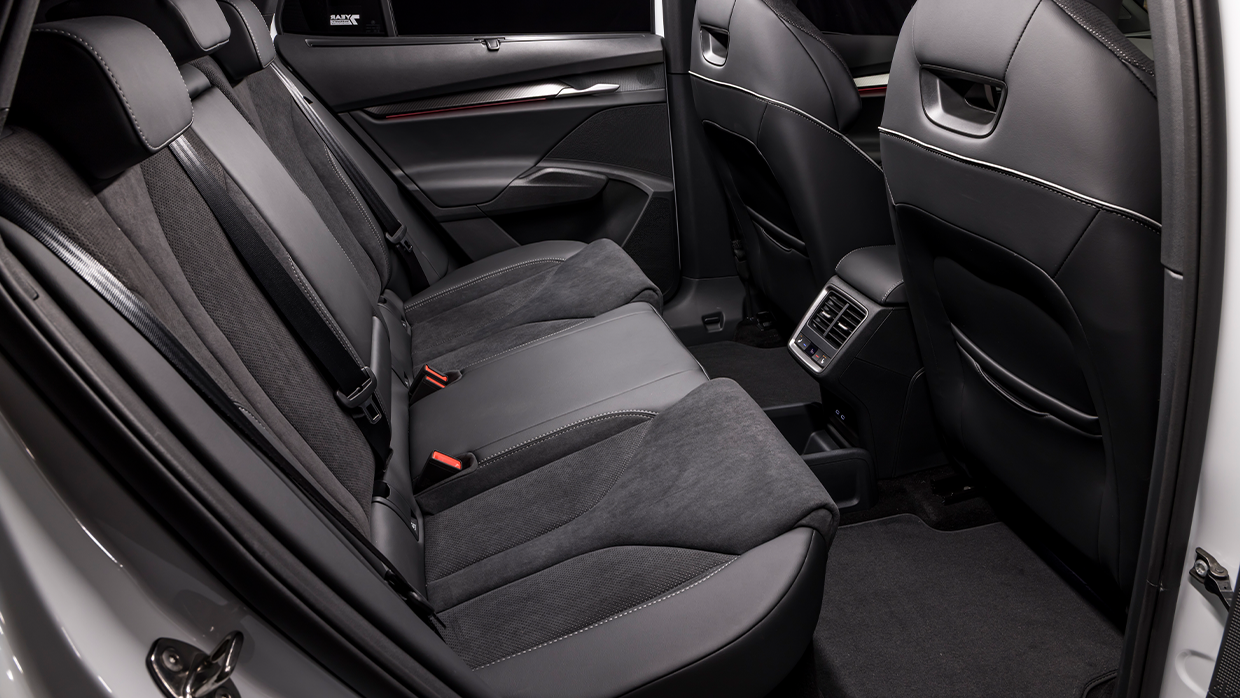
Skoda claims the smaller-bodied Elroq shares the same interior space and dimensions to this, the Enyaq twin with a larger 4.7-metre exterior footprint. And yet the somehow, placebo effect or not, the Enyaq’s cabin seems to be a little larger and roomier.
Up front, it’s nicely airy in ambience but doesn’t feel hefty and unwieldy (like Mitsubishi’s Outlander, say). But it’s really sat in row two looking forward where the sense of the sheer cabin length, and the clever interior packaging, really rams home.
Second row head and knee room are excellent, though the cosy cabin width really makes the Enyaq feel best suited as a four-adult proposition. As if to anchor the point, one example we tried fitted the removable floor-mounted storage box with cupholders, which is handy but does rob foot space (which is why it’s removeable, of course…).
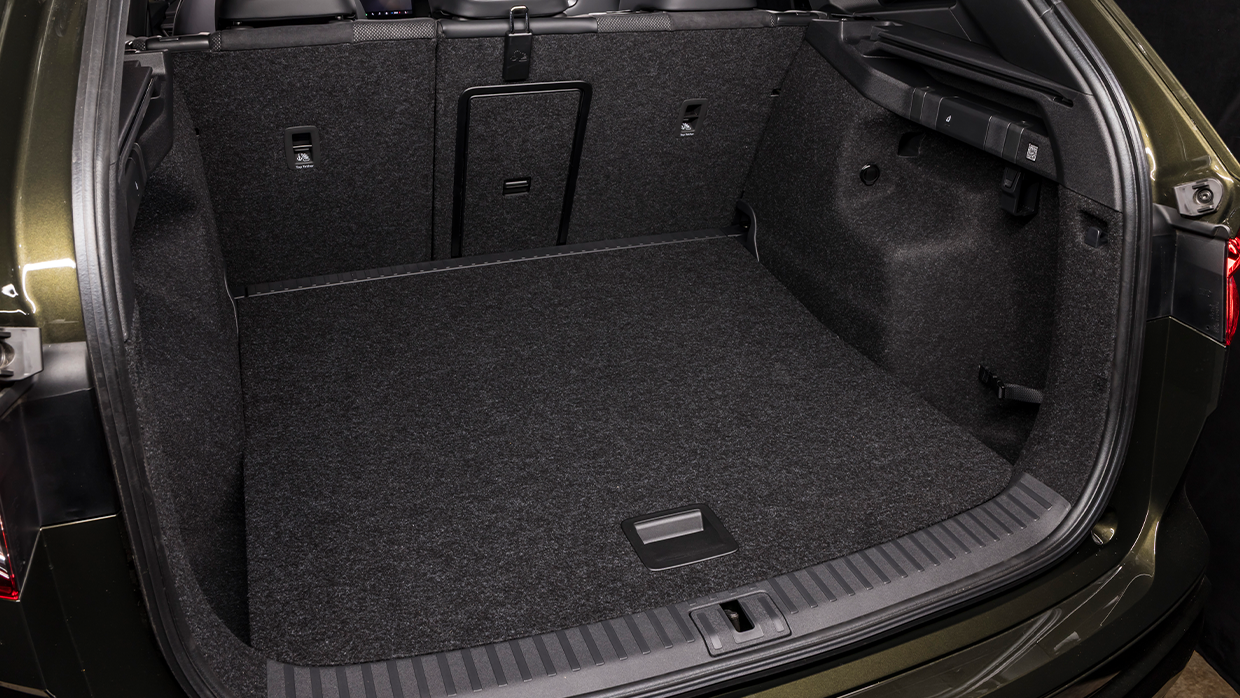
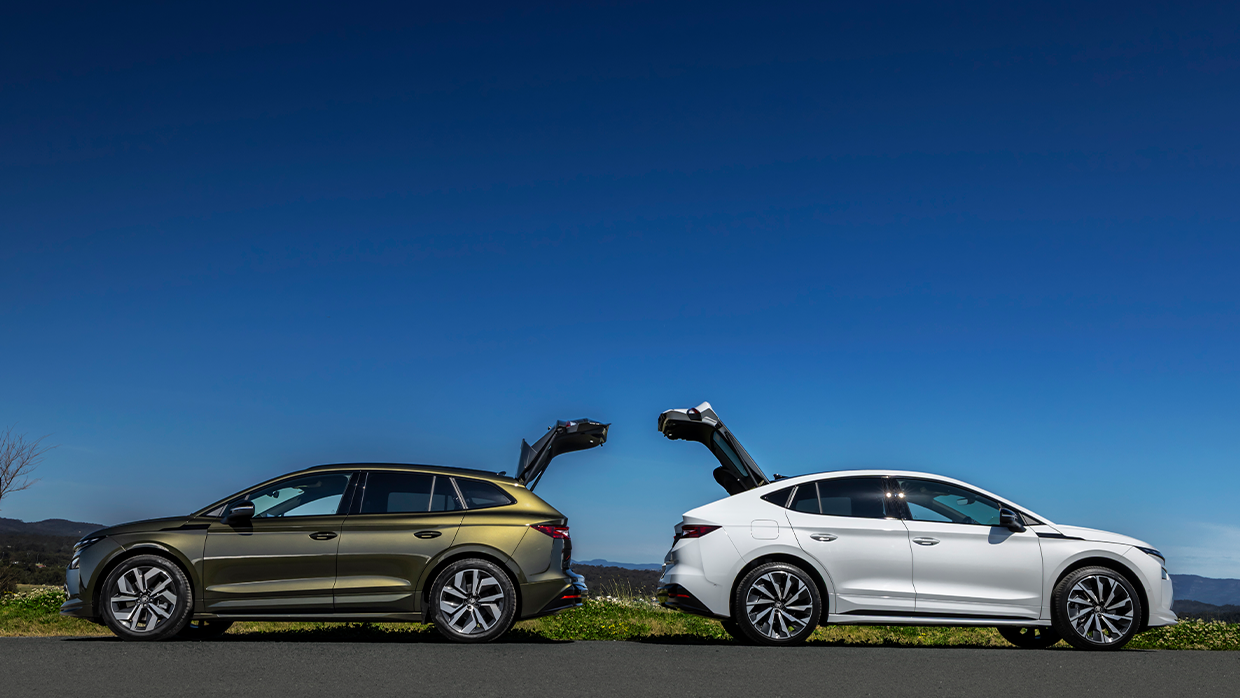
Elsewhere in the Enyaq’s bag of expected ‘simply clever’ tricks are phone pockets in the back of the front seats, automatic proximity door locking/unlocking, a QR code sticker in the boot to shortcut feature how-tos and, of course, the umbrella housed in the driver’s door.
Is the Enyaq 85 Sportline a safe car?
The Enyaq carries over the five-star ANCAP rating from the old ‘shape’ version from an older assessment regime as tested in 2021, which covers all variants moving forward.
It scored a resounding 94 percent and 89 percent for adult and child occupant protection, respectively, with 71 percent for vulnerable road user protection and 73 percent for safety assist.
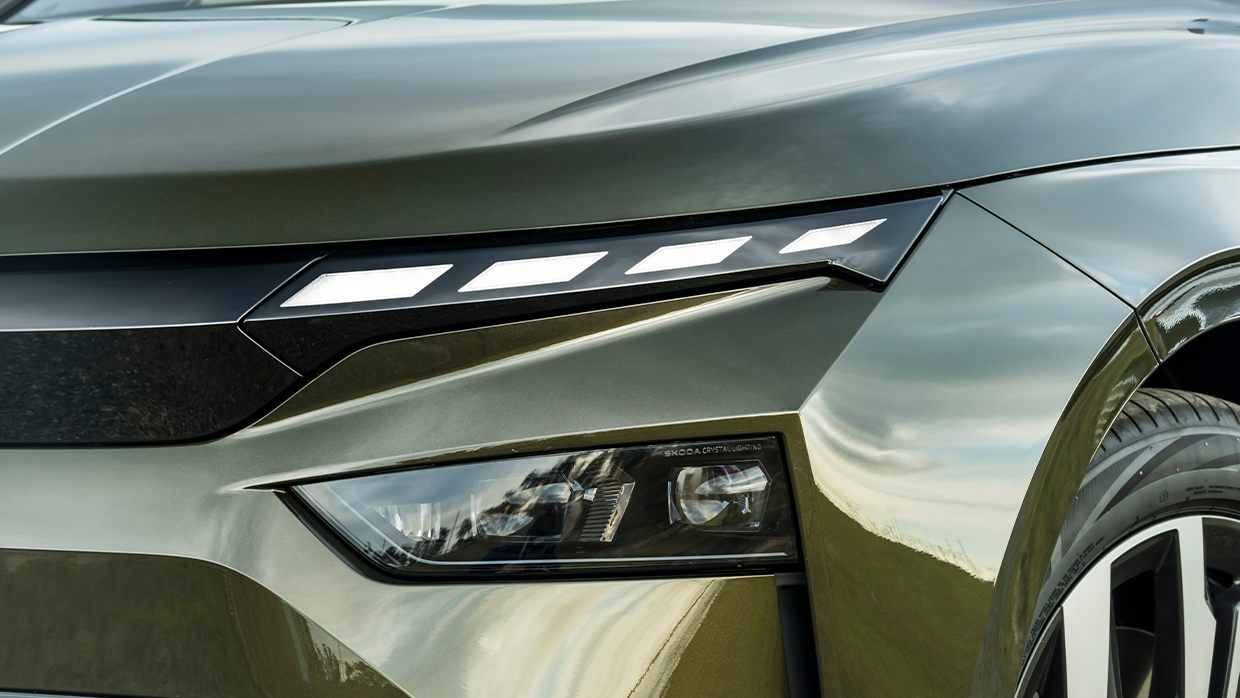
Features include:
- Front driver, centre and passenger airbags
- Front side and front-to-rear curtain airbags
- Rear side airbags (Sportline and Select grade w/ Signature package)
- Forward AEB with pedestrian and cyclist detection
- Turn assist
- Lane departure warning
- Lane keep assist
- Side assist
- Swerve support
- Rear traffic alert
- Safe exit warning
- Speed limiter
- Adaptive cruise control
- Front and rear parking sensors
- Reversing camera (Select)
- 360-degree camera (Sportline)
- Area view ‘overhead’ camera (optional, or Sportline Coupe standard)
The Enyaq’s systems appear well calibrated and were wholly unobtrusive on test bar the slightly enthusiastic lane keeping, which is easily switched off. Both the AEB — it’s a long story — and the stability control system worked faultlessly during our drive when triggered.
What are the Enyaq 85 Sportline’s ownership costs?
At a thrifty $1650 for an eight-year/120,000km package or $1950 for a 10-year/150,000km bundle, the Enyaq is remarkably cheap to service, averaging out to $206 or $195 per year respectively. Not only is this cheaper maintenance than Toyota BZ4X ($2504 for 10 years), Skoda’s 24-month/30,000km intervals are half as frequent.
As mentioned, the Elroq 85 Sportline wagon returned an indicated 16.2kWh/100km average for our assessment drive, against a 15.9kWh/100km combined rating. The aerodynamically slipperier coupe brings a more favourable 15.5kWh claim.
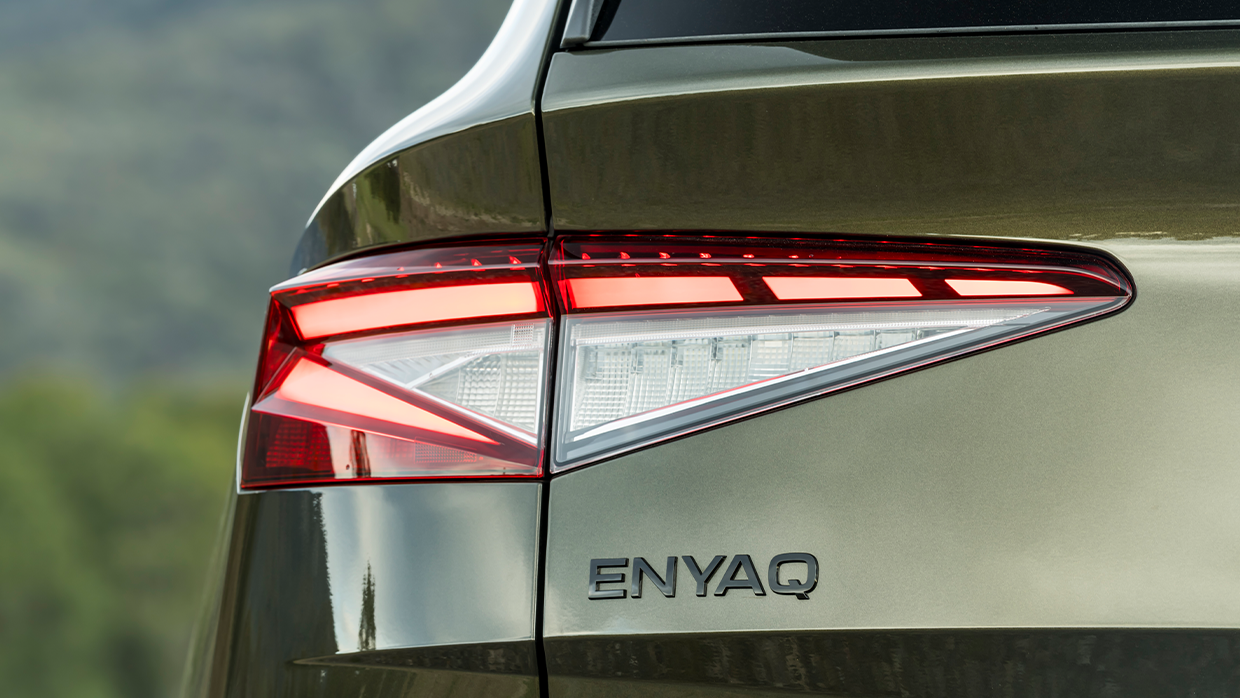
Range claims? Skoda says 547km and 561km combined (WLTP) for the wagon and coupe, respectively. The city cycle comes with claims of up to 687 kilometres for the slipperier coupe.
Peak DC charging power is down, from the old Enyaq’s 175kW to now 135kW, though Skoda says the 10 to 80 percent charge is roughly unchanged (28 minutes) due to a flatter charging curve. Meanwhile, the 0-100 percent AC charging time is around eight hours.
Warranty is seven years of unlimited-kilometre coverage, with eight years and 160,000km of surety on the high-voltage battery.
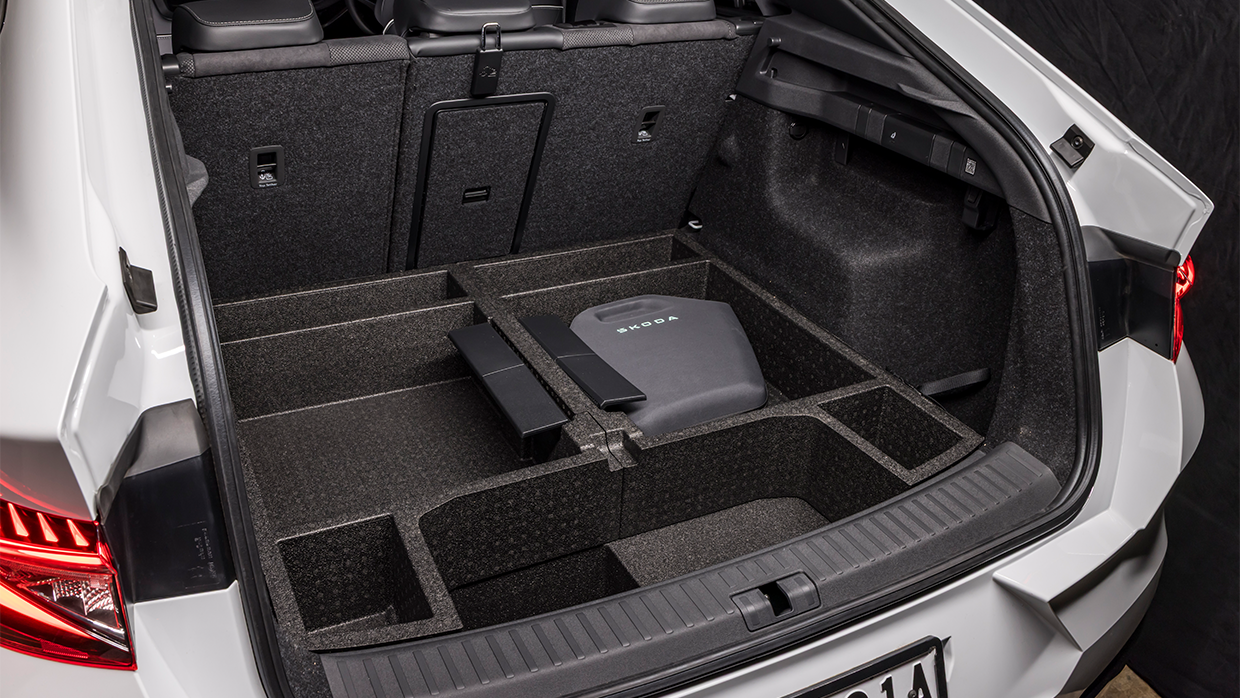
Unlike Tesla, the VW Group’s MEB platform offers a ‘modular repair concept’ designed with repairable cells, so that the whole battery doesn’t require replacing after a battery failure.
The honest verdict on the Enyaq 85 Sportline
Pivoting to a wagon-centric line-up with a broader variant choice makes our reigning Five-Seater Family Car of the Year a more compelling proposition. While the soon-to-launch price-busting $51K 60 Select and go-faster dual-motor RS (coming Q2 2026) will have their day, the ‘core’ 85 Sportline wagon already appears to be the sweet spot.
Skoda’s only mid-size SUV is a fine one at that. The wagon format improves practicality and appearances. Unlike the ‘family’ blobby Volkswagen IDs or ostentatious ‘Gotham City’ Cupras, the Skoda’s slick yet restrained styling arguably presents a more broad-reaching appeal.
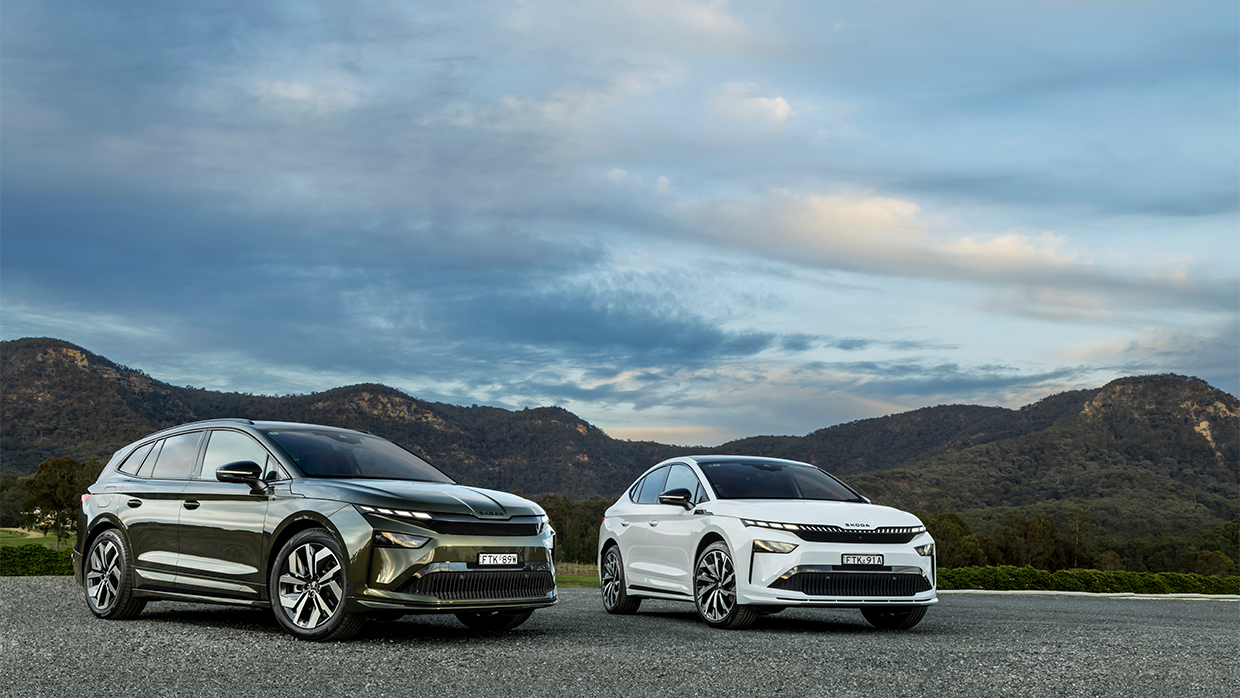
It drives like a fine European car as one conceived and built in Europe should. And it’s priced seductively, directly against Chinese-sourced rivals. Further, it offers buyers a familiar ICE-like experience, right down conventional Apple Carplay and Android Auto compatibility.
Is this the smartest offering from the ‘simply clever’ marque? Could be…
Perhaps the restyled, newly wagon-ed Enyaq will transform what has been a lukewarm local reception to Skoda electrics thus far.
Chasing more Enyaq?